Long time member, Patsy Cotterill reflects on SAPAA’s early days, people, and reasons for existence. This is also a way to honour Alison Dinwoodie 1932-2024 who passed away recently and was a driving force behind the organization for many years.
As documents and memories are uncovered, this post may be updated accordingly. Comments with memories are appreciated as well as electronic copies of Stewardship related documents. Please send these to webmaster@sapaastewards.com.
- The History
- Natural Areas
- Volunteer Steward Program
- Stewards of Alberta’s Protected Areas Association
- Demise of the Volunteer Steward Program
- The Present
- Deaf, Blind, but Still Alive
By Patsy Cotterill
(in honour of the late Alison Dinwoodie, recognizing her dedication to SAPAA)
The History
The Stewards of Alberta’s Protected Areas Association (SAPAA for short, pronounced sap-ar) got its start with an inaugural meeting on May 15, 1999. Its stated purpose was to be an “arms-length organization supporting the activities of stewards enrolled in the government’s Volunteer Steward Program of 1987.” Most of the stewards were of Natural Areas, the exception being a couple of stewards of ecological reserves and wildland parks.
Natural Areas
Natural Areas had been in existence since 1963 as areas of value for their natural environment, legislatively protected. Of varying size, they were intended to “bridge the gap” in Alberta’s system of Protected Areas between “strictly protected areas [e.g., wilderness areas and ecological reserves] and those lands intensively developed for recreation [e.g., parks].” Natural Areas were primarily intended for recreational use by a local public, and while the government would be responsible for the land base (as for all public land), it was never intended that budget should be allocated for intensive management or the development of facilities on site.
Most Natural Areas were classified as having Recreation as their purpose, but two other categories with somewhat different intents were recognized: Education (sites for teaching and research) and Conservation (conserving important habitats, landscapes and species). Ecological protection, however, was always the sine qua non of all types of Natural Area.
Rather than management by government, with the expense that this would entail, the idea was to engage the public in management of these sites, and it was envisaged that this could be done in several ways: through land trusts, dispositions, volunteer stewardship, payment for services (e.g., garbage collection) and direct financial contributions.
Volunteer Steward Program
Stewards of some sites had been in existence for several years before the official Volunteer Steward Program was formally announced in 1987. Thereafter, the stewards were to be the “eyes and ears” of the government, visiting their site and submitting a report on its status at least once a year.
In return, they were invited to an annual spring or fall conference with presentations and government updates, given all sorts of gear (some of us are still wearing the T-shirts and warm, fleece jackets that were handed out), and communicated with via newsletters.
Some stewards organized themselves into non-profit societies, allowing them more autonomy and self-sufficiency, and an ability to better manage, protect and promote their sites, although the government still retained responsibility for the land base and provided assistance. (This is still true today.)
Stewards of Alberta’s Protected Areas Association
Even so, it was not all beer and skittles for volunteers. Most stewards joined because they were nature lovers and maintaining the ecological integrity of their site was their prime focus.
But the wide range of public uses that were allowable in Natural Areas – including hunting, camping, existing oil and gas installations and off-highway vehicle riding – could make protection difficult. The sandhill areas north of Edmonton were particularly problematic because their undulating topography and open forests, along with their relative proximity to settled areas, made them particularly attractive to OHV riders.
Down south, in the foothills and mountains, some Natural Areas were suffering from increased use. As well, some stewards found they had to defend their site from outside development. The Wagner Natural Area Society, for example, was formed in 1982 not as a steward but as an advocacy group protesting the development of an adjacent major highway. It is still fighting today to protect its hydrology from surrounding adjacent development.
For several years after the Volunteer Steward Program began, stewards talked about forming their own mutual support group. Given the overweening recreational mandate, and the flexibility built into the governance of Natural Areas, the government was in a difficult situation, trying to be all things to all people. Stewards thought that an organization like SAPAA might collectively be able to influence the government towards giving greater weight to ecological protection.
It was not until May 15, 1999 that SAPAA held its inaugural meeting, with some 30-people attending, including three staff members from the Volunteer Steward Program. Alison Dinwoodie, who had been a leading proponent of a support organization since early on, chaired the meeting.
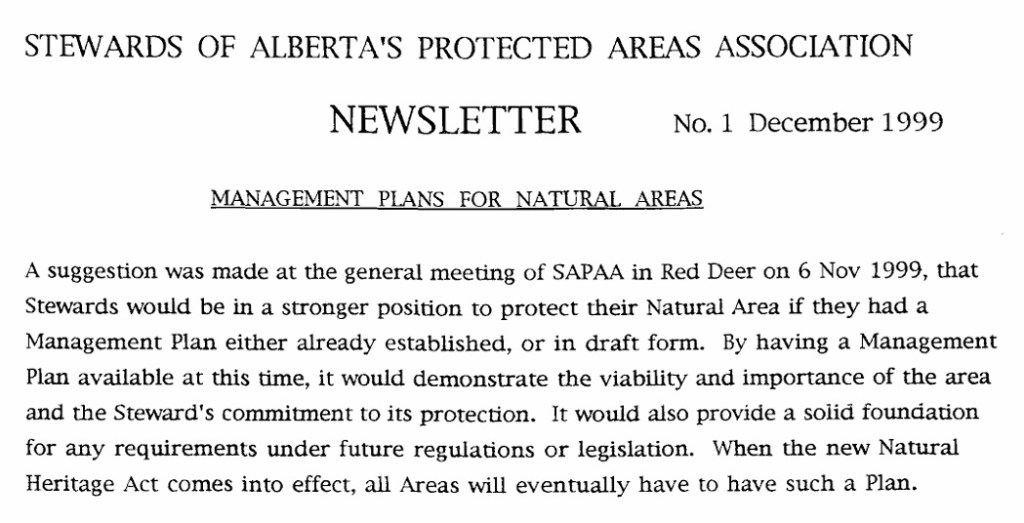
The first general meeting was held on November 6, 1999 at the Red Deer and District Museum and Archives, with 24 people in attendance and Alison Dinwoodie in the chair. Seven motions were passed defining the new organization’s objectives. The first three were as follows:
- Objective 1. Establish a network of volunteer stewards to exchange information and expertise, and to provide mutual assistance and support.
- Objective 2. Advocate for the preservation, protection and restoration of the ecological integrity of areas that represent Alberta’s natural ecosystems.
- Objective 3. Identify issues of common concern, in order to deal with them more effectively and comprehensively.
The other objectives involved working with government and other organizations to resolve issues, being represented at meetings on issues of interest, increasing public awareness of protected areas, and supporting the knowledge and skills of stewards through conferences, workshops, seminars and publications.
The membership fee was set at $15 (it hasn’t changed today) and plans were made to develop a set of bylaws before the next meeting to be held in May. The first (interim) executive consisted of Alison Dinwoodie as chairperson, John Woitenko as vice-president, Beth Jenkins as recording secretary and Marilyn Shannon as treasurer and membership secretary.
In the discussion that followed a number of questions were posed for consideration, such as the future of the Volunteer Steward Program and SAPAA’s role and relationship with government. These questions are still being asked today.
Despite its clear objectives, SAPAA had problems defining itself right from the start. Not all stewards joined SAPAA. Some welcomed the collegiality and solidarity, but others did not feel the need for it, and yet others were concerned that in advocating and criticizing the government they could be in conflict of interest. SAPAA was hampered in its efforts to recruit more stewards because for reasons of privacy the government did not make its list of registered stewards available.
Demise of the Volunteer Steward Program
Fast forward 15 years or so, and the Volunteer Steward Program is shutting down, not with a bang but with a whimper. No new stewards are being recruited (to non-stewarded sites) and departing stewards are not being replaced. Annual reports submitted to government, as far as we know, are not being acknowledged as staff are assigned to other duties.
The last stewards’ conference was held in Calgary on September 22-24, 2017. The newsletter had ceased circulation even before that. Tighter regulations regarding safety, and a fatal accident, made volunteers, the responsibility of the government while doing volunteer work at the government’s request and hence considered employees eligible for insurance, suddenly a liability rather than an asset.
In the absence of a functioning Volunteer Stewardship Program, SAPAA’s navel-gazing with respect to its role, its relevance and its relationship to government, intensified. Board members repeatedly canvassed themselves and the membership on whether SAPAA should fold, but a dedicated band of supporters urged it to keep going.
Some brief excitement was generated in 2021-2022 when the government commissioned the Miistakis Institute to survey stewards, with the idea of re-envisioning a stewards’ program that might involve an enrichment of duties with citizen science. It came to nothing, and SAPAA never got access to the survey results.
The Present
From the turn of the century to the present day, the status and future of Alberta’s protected areas system has been the subject of constant political discussion, ideas, plans and policies for change.
There were the proposed Parks Act and the Natural Heritage Act, meant to rationalize existing legislation for the Protected Areas system, which did not come to fruition, the Regional Land Use Plans (seven proposed, only two completed and no subsequent follow-up with the public), and the divestment of a list of parks and natural areas, a proposal abandoned by the government after public outcry. The public has recently been surveyed on an update to the Plan for Parks, and on their opinions regarding a Nature Strategy for Alberta.
Practical measures have been implemented in response to demands for public recreation; for example, in the provincial parks camping was expanded by the provision of more sites suitable for RVs, and facilitated by means of a registration system.
However, environmental protection has not to our knowledge been obviously advanced, with the exception of greater protection for the Castle Wildland Provincial Park | Alberta Parks in 2016.
Deaf, Blind, but Still Alive
The Volunteer Steward Program is defunct, but Natural Areas still exist and the government still has responsibility for them.
Stewards still exist, and SAPAA persists, and is still in communication with the government. SAPAA received a new-blood transfusion with the arrival of new board members whose organizational skills and tech savvy have resulted in a revamped and more sophisticated website, outreach to students and the development of a site inspection report form.
The latter is designed to give visitors an incentive to visit Natural Areas to report on their findings. SAPAA will receive and store the information but is working to make it useful to share with the government. Administratively, the SAPAA board is looking to improve the organization’s efficiency and sustainability, possibly by a merger with a larger organization.
To use a metaphor: the road ahead for SAPAA lies shrouded in fog. On the other hand, those of us who are visiting and stewarding sites are experiencing an ongoing appreciation of our province’s wonderful natural ecosystems and landscapes, well worth protecting.

Wagner is considered the “flagship” Natural Area. In existence as a protected area since 1975, and stewarded by the Wagner NA Society since 1982, it ticks all the boxes. Its rich fens are environmentally significant and support wildlife and a diversity of plant species including some rare ones, it has been used for teaching and research and, close to large centres of population, it is enjoyed by an ever-increasing number of members of the public.
Not all of the 248 protected areas can be a Wagner, but at a minimum, all deserve some form of stewardship.
 SAPAA
SAPAA 
Pingback: Creating Citizen Stewardship | Organizational Biology
Pingback: Volunteer Stewardship – Backgrounder | SAPAA
Pingback: CBC Story – Volunteer Stewardship Program | SAPAA
Pingback: CSL Projects – SUST 202 | SAPAA
Pingback: Using iNaturalist Data for Good | SAPAA
Pingback: 2025-06-12 Grant MacEwan PM Capstone Introduction | SAPAA
Pingback: Student Opportunities – 2025 to 2026 | SAPAA
Pingback: Alberta Rural MLAs and SAPAA – 2026-03-20 | SAPAA