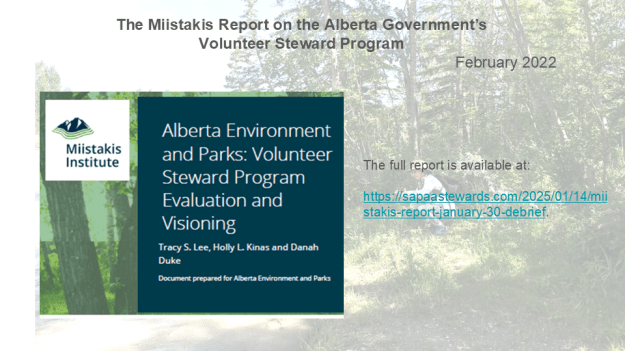
The 2022 Miistakis Report evaluated Alberta’s lapsed Volunteer Steward Program, revealing significant weaknesses like insufficient support and lack of data on conservation impacts. It recommends reintroducing citizen science, enhancing government capacity, and employing modern technology for data management. This Post provides notes on from the Miistakis Report – January 30 Debrief.]
Editor’s Notes
(edited by Frank Potter)
The following analysis was created by long-time SAPAA member and Board Secretary Patsy Cotterill. Graphics interspersed in this post were from Patsy’s excellent presentation held on January 30, 2025. Not recorded, the following should be considered the notes. The original deck can be downloaded as well. Paragraphs in italics indicate SAPAA’s comments. Graphics interspersed are from that presentation.
- Editor’s Notes
- Setting the Context
- What Did Miistakis Do?
- Wish Lists and Significant Problems
- Recommendations/Solutions
Setting the Context
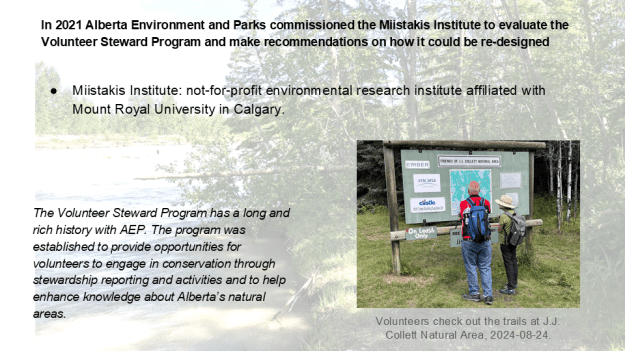
In 2021 the Government of Alberta commissioned the Miistakis Institute, an environmental research organization based out of Mount Royal University in Calgary, to review the lapsed government Volunteer Steward Program and make recommendations for its re-envisioning.
The program has not recruited new stewards in 13 years and has retracted from many of its previous supportive functions. The “Alberta Environment and Parks: Volunteer Steward Program Evaluation and Visioning” (Miistakis Report) was completed in 2022 but, despite repeated requests from SAPAA, the government declined to make it public.
Following a Freedom of Information and Protection of Privacy (FOIP) request by CBC News Edmonton for a story on the Volunteer Steward Program aired on January 4,2025, this document is now available and is published on the SAPAA website. Reading it, given its straightforward language and absence of apparently controversial political content, one has to wonder why it has been kept secret for so long?
What Did Miistakis Do?
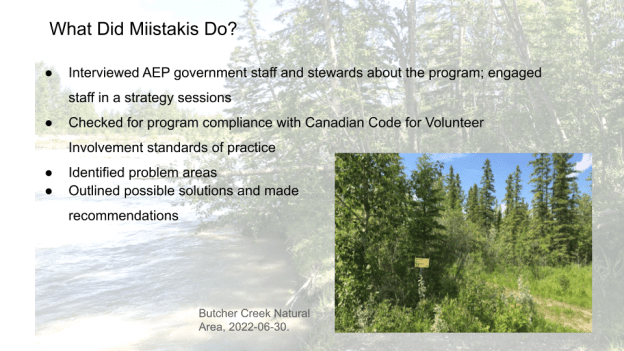
Stewards and Alberta Environment and Protected Areas staff were interviewed for the study, and the latter were also engaged in strategy sessions. The responses from stewards were not sufficient in number to provide a truly representative sample, but nevertheless provided good insight into stewards’ opinions of the Program.
Wish Lists and Significant Problems
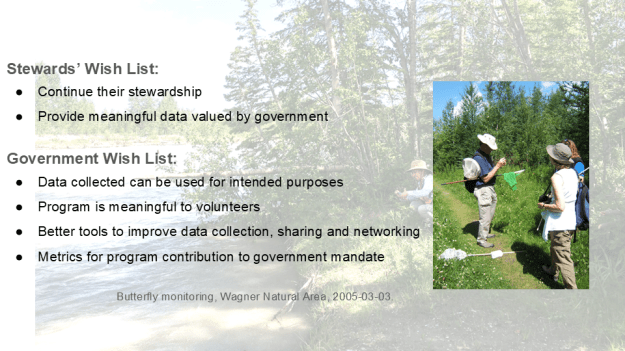
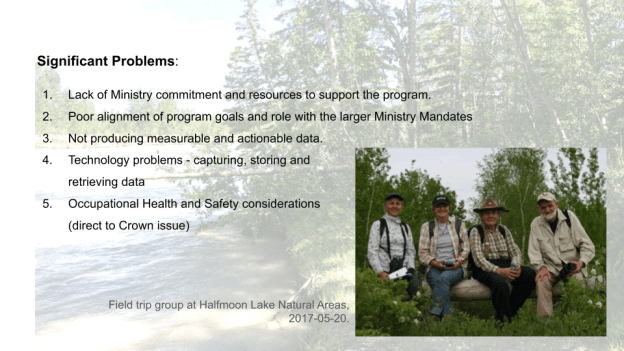
Stewards expressed a general wish to continue their stewardship activities but regretted that their efforts were not sufficiently valued by the government. Accordingly, key weaknesses identified in the report were a lack of leadership support and insufficient program support from Alberta Environment and Parks.
Lack of support was manifest in the absence of feedback from the government, as identified by stewards, as well as a lack of networking opportunities among stewards and their sites. Stewards expressed a desire for a program website that would allow viewing of reports from other Natural Areas across the province, identified lack of training as a problem, and above all, wished for their contributions to be meaningful.
For their part, the government reported internal challenges such as a lack of staff capacity, unclear goals and objectives for the program, problems with compliance with more onerous health and safety and insurance requirements for volunteers, and inaccessible data and an unsupported database (Paradox).
Interestingly, staff input suggested another omission that may have contributed to the decline of the program. While staff conceded that the inspection and reporting (the “eyes and ears“) aspects of the program had been successful, they noted that “the program lacks evaluative tracking metrics, and therefore the conservation impact of the program to natural areas is not well documented nor measurable.”
Hence, changes in conditions over time can’t readily be measured or understood or comparisons between sites made, resulting in a lack of reliable data on which conservation decisions can be made.
Patsy: As a long-time steward I find this a little ironic. It seems that the government did have higher expectations of stewards than merely being observers, and indeed in the early days of the program government ecologists made considerable efforts to improve students’ environmental knowledge and train them in monitoring protocols.
Stewards for their part have consistently indicated interest in protection and conservation of their natural areas as main motives for their stewardship. I might add that monitoring pre-supposes management action will be taken where indicated. However, in terms of sites where remedial ecological management or restoration has been undertaken it is hard to find examples.
Recommendations/Solutions
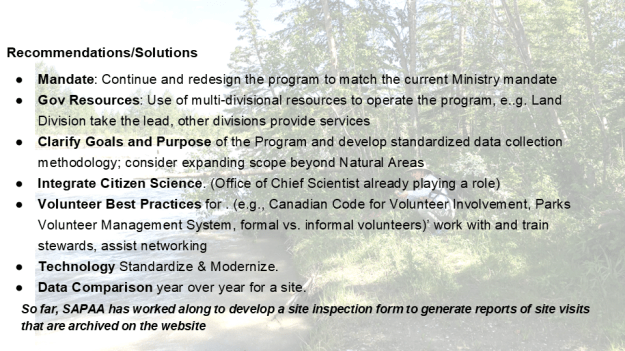
To remedy the lack of data with significance for conservation, the study recommends introducing more citizen science into a revamped program. A possible facilitator for this may be the Citizen Science Alberta Community of Practice that has been in existence since 2018. It was founded by the Department of Environment and Protected Areas’ (then Alberta Environmental Protection) by the Office of the Chief Scientist, which currently also finances its website although not its day-to-day operations. (See this issue’s article on SAPAA’s AGM.) Characteristically, although it is relevant to SAPAA’s interests, we had not heard of it until recently.
The report makes a number of key recommendations to solve the challenges identified with the program. Government capacity to support the program could be increased using cross-divisional resources, having the Lands Division, the Parks Operations Division, the Stewardship Resources Division and the Office of the Chief Scientist all pitch in, with a proposed transfer of the program lead from Parks and Operations to the Lands Division.
In addition, modern technology could be used to improve means for data collection and sharing, and networking.
The report concludes by recommending stewards should be engaged in a renewed program that would inform government science goals, document on-site activities and meaningfully engage or partner with Albertans.
The government for its part has stated its intention to re-establish the Volunteer Steward Program, using guidelines informed by the Miistakis report, but has not specified timelines.
The report notes that the original Volunteer Steward Program was envisioned as contributing to the government’s public education and outreach goals. SAPAA supports this as a laudable objective. Not only will ecologically and geographically literate stewards get more value out of their stewardship but also they will contribute to a like-minded wider “community of stewardship” and a paradigm where society respects conservation as an important goal.
The full details of the report are in the Appendices, with additional material such as the Canadian Code of Volunteer Involvement and the Citizen Science Alberta Community of Practice.
 SAPAA
SAPAA 
Pingback: 2025-06-12 Grant MacEwan PM Capstone Introduction | SAPAA
Pingback: Unredacting 40 Years of Stewardship | SAPAA