Unfortunately, a change in research priorities has resulted in this project being cancelled. Ferf wishes to thank everyone who expressed interest and encourages you to go out an iNaturalist anyway.
The white spruce, Picea glauca, is a familiar conifer. A UofA researcher needs SAPAA’s help identifying stands of white spruce this summer through iNaturalist observations. While you are there, why not submit a Site Inspection report!
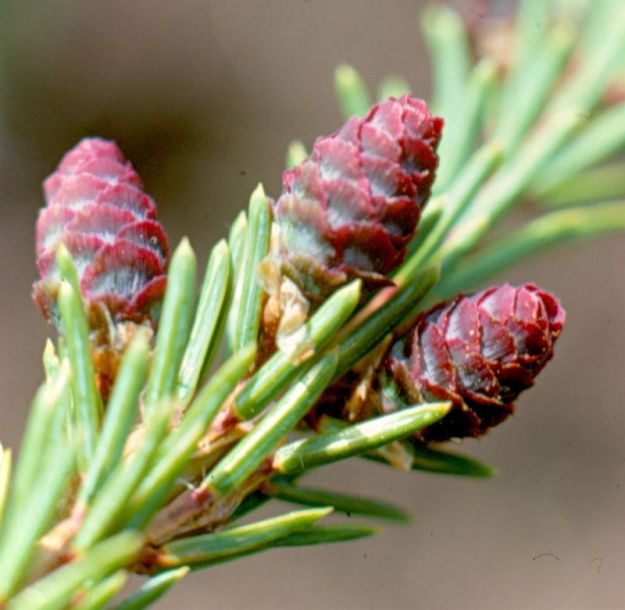
- Rooting for Mycorrhizae
- Ferf is Asking for Help from (and Providing it to) SAPAA
- What Happens to the Observations and Why Involve SAPAA?
- Seeing the Forest for the (White Spruce) Trees
- Sprucing Up Your iNaturalist Observations
- The Legal Cavet-ee Stuff – You are NOT a Volunteer
- Notes and References
The Government of Alberta’s AI search engine describes this tree as [1]:
A white spruce tree, known scientifically as Picea glauca, is a coniferous tree native to North America, particularly found in Alberta. It typically grows to heights of 15 to 30 meters and has a conical shape with a narrow crown. The bark is thin and scaly, often grayish-brown in color. The needles are short, measuring about 1 to 3 centimeters in length, and are arranged spirally on the branches, giving the tree a dense appearance. The cones of the white spruce are cylindrical, measuring 5 to 10 centimeters long, and are green when young, turning brown as they mature.
White spruce is valued for its wood, which is used in construction, paper production, and various other applications. It also plays a significant role in forest ecosystems, providing habitat and food for wildlife.

Rooting for Mycorrhizae
At the base of a white spruce (and every other plant in existence) is a small symbiotic miracle, the mycorrhizae [2]. This is a symbiotic association between fungi and the roots of plants. This relationship enhances nutrient uptake for the plant, particularly phosphorus, while the plant provides carbohydrates and other organic compounds to the fungi.
Mycorrhizal fungi extend the root system of the plant, increasing its ability to absorb water and nutrients from the soil. This association is crucial for plant health and growth, especially in nutrient-poor soils.
Ferf is Asking for Help from (and Providing it to) SAPAA
A friend of SAPAA, Christopher (Ferf) Brownoff is a PhD student at the University of Alberta who studies Mycorrhizae. He was initially engaged as part of our iNaturalist initiative to provide a researcher and user’s perspective on the value of the tool. He also has a research question pertaining to the white spruce, ‘where can I readily find naturally occurring stands of white spruce within a 2-hour’ish drive from Edmonton?‘.
The reason the researcher is interested in communities of White Spruce as distinct from isolated trees. Natural stands are required as replanted stands may have introduced foreign colonies into the soil.
What Happens to the Observations and Why Involve SAPAA?
Normally Ferf would use satellite imagery and sort through government sources for this information. This is time intensive and not always accurate.
Once a stand is located, he can then visit, take samples, do research-ee things, and write techie papers in scientific-ee journals (editors note, why yes – I am way out of my comfort zone writing this…).
The point being, knowing where there are good clumps of white spruce will save Ferf gas and time and advance scientific knowledge. It is also a darn good excuse to visit Alberta’s Protected Areas, look at the trees, snap iNaturalist observations, and hopefully submit a Site Inspection.
For SAPAA, we hope to generate more Site Inspections and also see how integrating iNaturalist can benefit our members and friends of SAPAA. For the observer, they get to go and look at trees!
Seeing the Forest for the (White Spruce) Trees
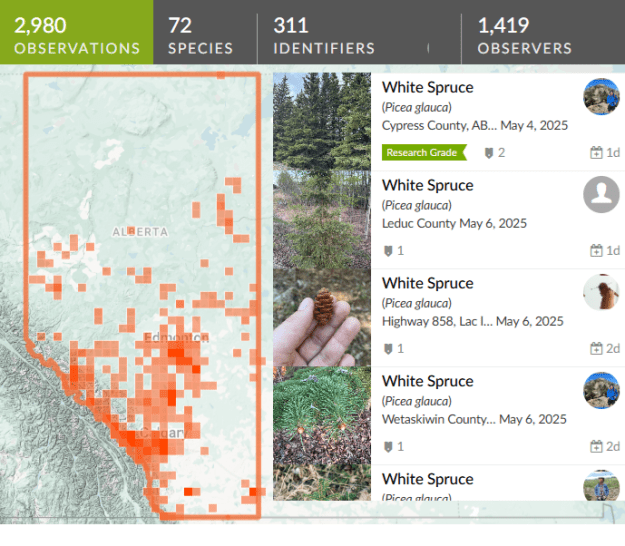
At the time of writing there were a little over 2,500 white spruce observations in Alberta. Being a common tree, it is surprising there are so few. On the other hand, being a common tree, most people would walk by it in search of more interesting stuff.
Sprucing Up Your iNaturalist Observations
How can you help?
- Become an iNaturalist member (if you are not already).
- Know what a white spruce looks like (use this handy SAPAA Guide: Getting to Know Alberta’s Coniferous Trees | SAPAA)
- Attend a kick off webinar where Ferf will explain his research and describe a white spruce. Webinar details are: [PENDING]
- Go visit protected areas (and other locations) and look for white spruce trees noting the following requirements:
- a. The stand of trees is about 100 or so individual trees.
- b. A stand that is at least 100 M or more in the smallest dimension.
- c. Not a cultivated stand (e.g. planted by humans).
- d. Has about 30% or fewer other tree species.
- e. There is a good mix of mature younger trees.
- f. Ideally, less than a two-hour drive from the University of Alberta (but all observations are welcome!).
- Submit iNaturalist observations of the trees (and Site Inspections).
- a. Please submit at least 3 observations for the stand.
- b. Provide a landscape image of the stand in its entirety.
- c. Best effort within a 15-minute or so time period is greatly appreciated.
- Look forward to your name being listed on a future peer review journal (okay, this is a long shot).
The Legal Cavet-ee Stuff – You are NOT a Volunteer
Due to insurance and occupational health and safety reasons, SAPAA is NOT asking you to volunteer and go look for the trees. However, if you are in the forest anyway, please consider doing the above. You might be going out on a private trip, with another organization, or other circumstances.
Notes and References
- Search conducted 2025-05-08, Alberta AI Search.
- For an overview, watch: How Trees Secretly Talk to Each Other in the Forest | Decoder – YouTube
 SAPAA
SAPAA 