Patsy Cotterill and Manna Parseyan explored the Bellis area and discovered Yellow, Green and Blue: Aspen Forests, Jack Pines and Lakes. They recorded over 100 plant species amidst various ecosystems, including aspen and jack pine forests. Their trip highlights the area’s potential for future exploration, particularly regarding wetlands and diverse vegetation.

by Patsy Cotterill, Manna Parseyan.
We (Patsy and Manna) began the trip by visiting Bellis Beach Lake Nature Recreation Area, south of Highway 28 some 22 km east of Smoky Lake. Located at the bottom of Range Road 152 off Highway 28 before it turns west and becomes Township Road 592A, the day use area provides parking, picnic tables, toilets, and access to, and an excellent view of, this picturesque lake lying in a steep-sided wooded valley. Much of the lake is located in the extensive PNT portion of Bellis Lake Natural Area (451 ha.)
Note for the future: the day use area provides a suitable gathering place for a communal field trip. (A campground is located in the adjacent forest.)
Exploration of of the Bellis System
After having lunch at the recreation area, we returned west along Highway 28 to Range Road 153 and headed south to locate the southeast corner of the OC’d natural area (62 ha), before heading north again and parking just off-road at a sandy blowout area rutted by quad tracks.
Powerline Access
The powerline stretching north-eastwards provides easy access to the natural area and we noted that this linear disturbance had been revegetated (sown) with native grasses that typically colonize sandy soils: Rocky Mountain fescue, bearded wheatgrass, plains reedgrass and hairy wildrye. Sand grass and June grass were extensive on the lower slope near the road and may have been of natural origin, as was that excellent colonizing forb field wormwood.
We located no formal trails in this eastern part of the natural area, and the only sign of human disturbance was the presence of non-recent truck tracks along the powerline right-of-way. Nevertheless, walking is easy in the open jack pine forest on the plateau adjacent to the highway, where shrub cover is sparse, and small deer trails allow easy movement through the relatively open aspen forests that clothe the slopes.
A Lake With No Name
We explored the north shore of the unnamed lake which lies in a valley surrounded on three sides (except the south) by steep banks that have been denuded of tree cover by beavers. Beaver activity was also very obvious by the presence of deep channels incising the shore line and a large beaver lodge to the west.
Natural Regions and Botanical Diversity
Bellis Lake Natural Area is located in the Dry Mixedwood Natural Subregion of the Boreal Forest Natural Region amid rolling dune topography of sandy hills and large depressions filled with water or variously vegetated.
We recorded over 100 species of vascular plants, and distinguished the following plant communities, which contribute significantly to the botanical diversity:
- Upland:
- Open (treeless) vegetated slopes (sandy substrate visible); e.g. powerline ROW and slopes adjacent to road access
- Dry, aspen forest with occasional jack pine and white spruce (abundant understory of velvet-leaved blueberry), mostly on dune slopes
- Open mature jack pine forest with graminoid-forb and sparse shrub cover
- Shrub-sedge wetland in shallow ravine
- Lake/valley:
- Aquatic vegetation of lake
- Muddy lakeshore and beaver channels
- Vegetated lakeshore, mainly with marsh reedgrass
- Lower slope, sparsely treed, with mixed shrub-herbaceous species; landscape controlled by beaver
Question: Jack Pine or Aspen Forests?
What conditions favour jack pine forest over aspen forest on a sandy substrate? Topography, fire? (Aspen regenerates better than jack pine after a fire if conditions are not suitable for germination of jack pine seed).
A burn apparently affected a portion of the NA in 2002; the aspen forests could be more recent than the jack pine. Jack pine also appear to be more common on flatter ground.
Worthy of a Future Visit(s)
This kind of terrain is extremely pleasant to be in. We did not explore the creek feeding Bellis Lake proper (outside the NA), the eastern portion of the NA or the extensive PNT lands. Hence there is plenty of scope for future exploration! We hope to be able to find more extensive jack pine forests and a variety of wetlands, including peatlands.
The following table lists the 24 site visits recorded for Bellis Lake Sites (2 x NA; 2 x PNT).
| Steward | 199X | 200X | 201X | SAPAA | Total |
| Redacted | 7 | 13 | 3 | 23 | |
| Patsy C. | 1 | 1 |

Sandy slope south of access point on RR 153. 
Powerline showing grasses used in revegetation. 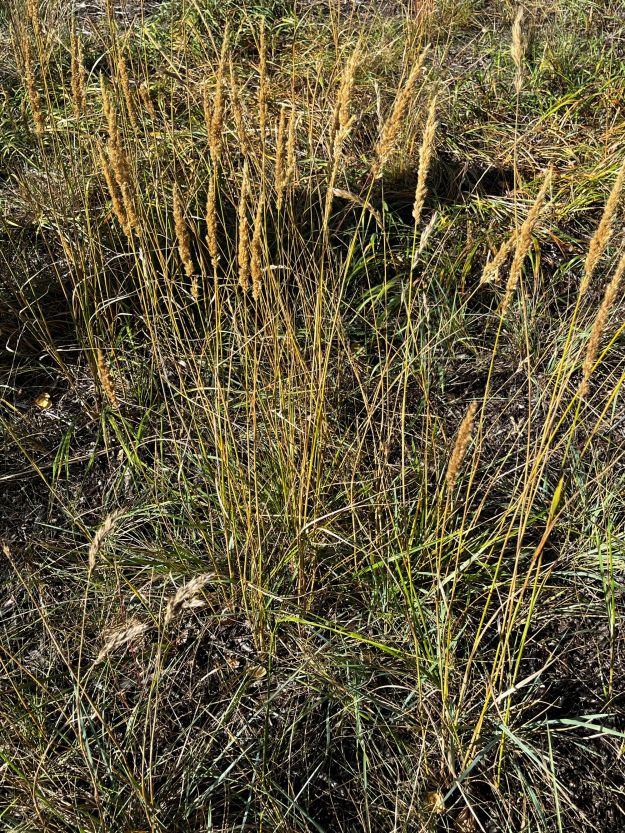
Plains reedgrass sown to revegetate the powerline. 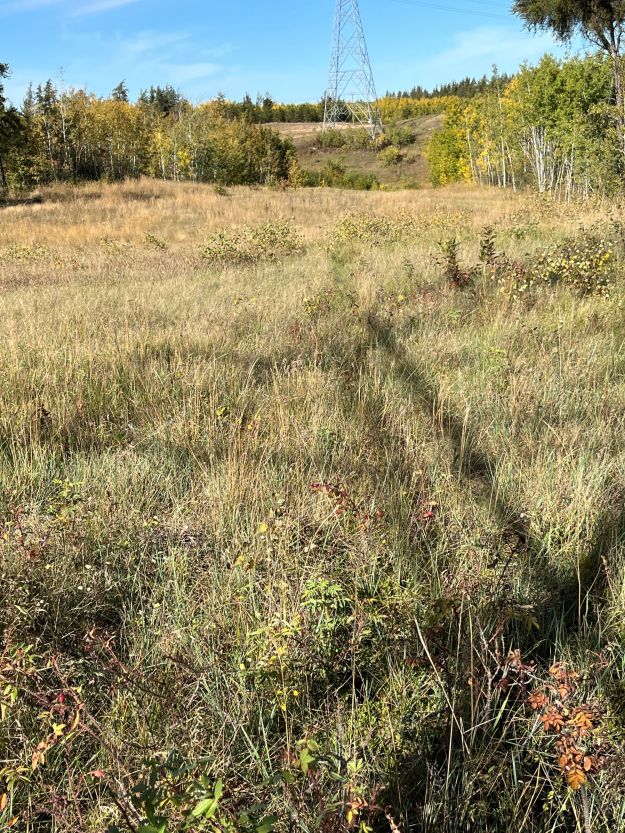
Powerline looking northeast. 
Area of open jack pine with dry aspen forest on slope in the background, 
West end of lake seen from north slope. 
Northern pocket gopher mounds in open area near lake. 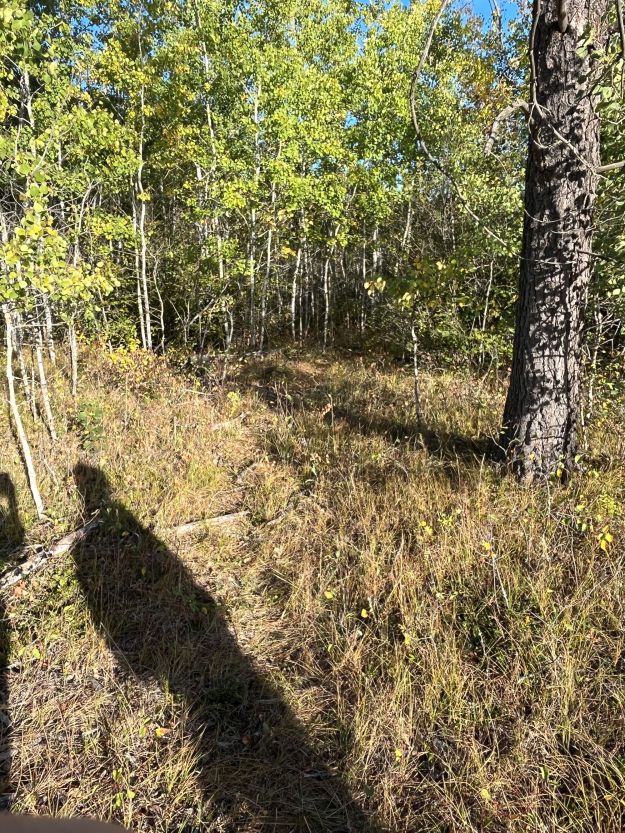
Deer trail providing quick access to the lake from the powerline.
 SAPAA
SAPAA 