Happy 5th Birthday to the ‘new website’. It was born on November 4, 2020, and, like any good five-year-old, has been growing! The 2025 report looks back at the site with some (hopefully) interesting statistics!

- Overall Results
- Most Popular Content and Pages?
- Who, How, and When Did They Find Us?
- Why Does This Matter?
- How Can You Help?
Overall Results
The above chart shows the year over year growth of visits and visitors to SAPAA’s website. On an annual basis (January to December), both values have increased at least 50% over the prior year. This is important as it positions SAPAA as an authority on the protected areas.
Most Popular Content and Pages?
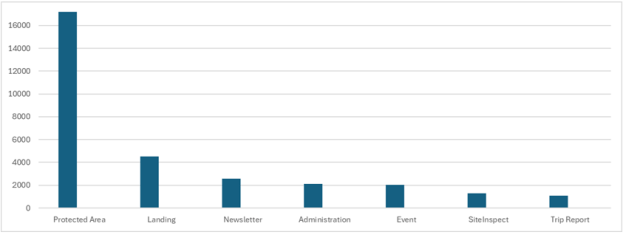
The Protected Areas themselves are the destination for most visitors. What is a landing page? It includes the ‘Home’ page itself (which has been dropped from this analysis) and is things like the list of Protected Areas or the list of Newsletters.
Setting aside these ‘administration’ pages, what are the top most visited protected areas? Drum roll please; these sites have had 200 more visits over the past 5-years!
- Kootenay Plains Ecological Reserve (615)
- Clyde Fen Natural Area (608)
- Northwest of Bruderheim Natural Area (414)
- Halfmoon Lake Natural Area (395)
- Wagner Natural Area (248)
- Tolman Badlands Heritage Rangeland and Dry Island Corridor Natural Areas (242)
- Lac La Nonne Natural Area (239)
- Tawatinaw River (PNT) and Perryvale (CNT) Natural Areas (223)
- Genesee Natural Area (216)
- Isle Lake Natural Area (215)
- Thorsby Natural Area (214)
- Redwater River Natural Area (208)
- Burtonsville Island Natural Area (208)
Who, How, and When Did They Find Us?

Most visitors are from Canada (31,000) with the United States (4,000) a distant second. Countries with known scammer and spammer presence are thankfully in the hundreds of visits over the past five years. As our internet search presence changes, this will likely change as well.

Search engines (e.g. Google) are the primary way by which visitors find us. SAPAA has gone from ranking many pages down to often being second only to the Government of Alberta’s reference for a site. Facebook is another good source which has been neglected this past year due to volunteer capacity. Nevertheless, a resource to keep in mind for 2026!

Generally, site traffic increases during the field season (roughly April to October) and quiets down during the off-season. This is a consideration for when to post trip reports or run events.
Why Does This Matter?
The WAERNAHR protected areas are an unique resource for Alberta. They are also virtually unknown outside of the small environmental community. They represent a resource worth preserving and a destination to appreciate nature.
The website provides ‘passive communication’. It tells the protected area story twenty four hours a day with no intervention by volunteers. This does not mean the website is entirely free. It costs a few hundred dollars a year to run (currently funded by a member) and few dozen hours a year to maintain (2025 is an exception with the integration of iNaturalist.ca).
How Can You Help?
You can help by simply visiting the website and enjoying the content. Links to the site via your social media also generates traffic and increases our credibility and search rankings. These are things you are likely doing anyway.
If you have a bit more time and talent, a volunteer role has been established if you want to help generate content (e.g. write up of site inspection reports). Hopefully you enjoyed your (virtual visit) to SAPAA, see you in a Protected Area!
 SAPAA
SAPAA 
Pingback: 2025 AGM Registration | SAPAA