The March 20, 2026, session informed Alberta’s MLAs about the WAERNAHR Act, emphasizing the importance of protected areas for biodiversity and local economies. It aimed to raise awareness of challenges these areas face and promote responsible use. SAPAA plays a key role in stewardship and monitoring these lands.
Download: Briefing Note for this meeting; Riding & Site Count: RuralMLA_SiteCount.
Riding/Protected Areas Map (same as the Annex Below)

Kenneth Hynek from Edmonton, Canada, licensed under the Creative Commons Attribution.
- Post Session Update
- MLA Meeting Material
- Why Are We Here? (Slides 1-5)
- Land Ownership in Alberta (Slide 6)
- Meet My Good Friend WAERNAHR (Slide 7)
- The Good News About WAERNAHR (Slide 8)
- Tragedy of the commons (Slide 9)
- Nearby Residents and Their Concerns (Slide 10)
- What is SAPAA Doing to Help WAERNAHR (Slides 11)
- How MLAs and Citizens can Help? (Slide 12)
- Thank You!
- Annex – Map of Alberta Provincial Ridings and Protected Areas
Alberta’s Protected Areas were set aside decades ago for the benefit of future Albertans. It is critical to remind new generations of the reason for their creation and the current challenges they are facing. This is the purpose of an information session held on March 20, 2026 with Members of the Legislative Assembly (MLAs) of Alberta.
Post Session Update
Unfortunately none of the invited MLAs were able attend this session. SAPAA will continue to engage MLAs through other means such as direct mailings, interviews, etc. A huge thank you to the MLAs who did send regrets and expressed interest in this session.
MLA’s will benefit from this session and can help Protected Areas by doing the following:
- Awareness of the WAERNAHR Act and the role these small Protected Areas play in biodiversity, rural lifestyle, and economic activities such as tourism.
- Recommend residents safely visit these areas and send SAPAA a Site Inspection Report on their status: Site Inspection Form.
- Encourage responsible and sustainable use of these areas.
MLA Meeting Material
The following are the slides and speaking notes. They are provided for the benefit of the attendees and the MLAs who could not attend the session. Not all slides are included from the deck presented for brevity. This post contains supplementary notes and links on specific topics.
Why Are We Here? (Slides 1-5)
Key Messages
- THANK YOU!
- MLAs are busy and budget season is particularly so.
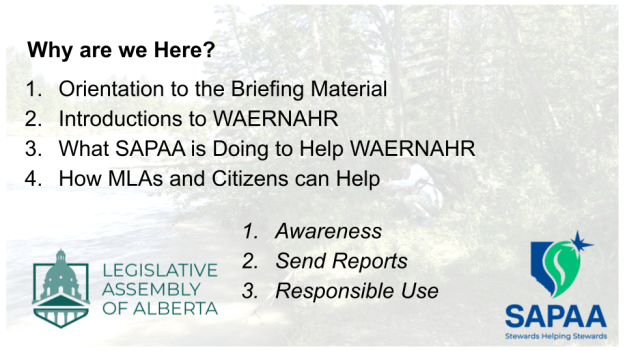
Key Messages
- Awareness of WAERNAHR
- Reporting on WAERNAHR
- Responsible Use to sustain and improve a Rural Lifestyle
Further Reading and Notes
- We are a non-partisan and non-profit society whose purpose is to support stewards of Alberta’s protected areas.
- The Society was formed in 2000 to assist stewards enrolled under the government’s Volunteer Stewards Program (1987) serving the Alberta government’s protected areas network.
- To learn more, see: A Short Selected History of SAPAA, and Volunteer Stewardship – Backgrounder.
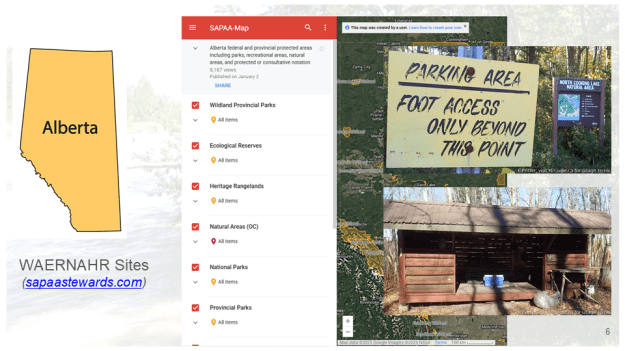
Land Ownership in Alberta (Slide 6)
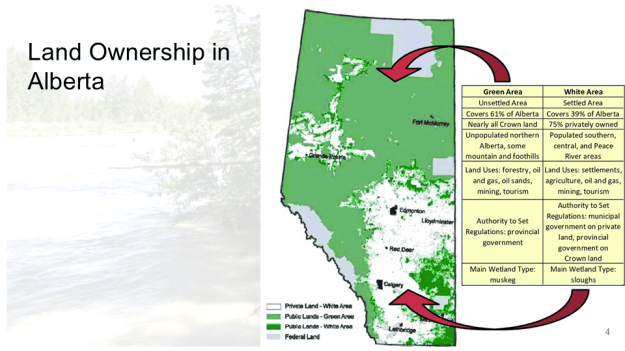
Key Messages
- ~60% of Alberta is Crown Land.
- First Natural Areas, 1963
- WAERNAHR lands cover an area of about 3,280 Square KM (about half again the size of Luxembourg, see Counting Protected Areas).
- To read more on these designations, visit: Protected Areas.
Further Reading and Notes
- Natural Areas have been added to and evolved over the intervening years (see A Short Selected History of SAPAA).
- Federal, Municipal, First Nation, and protected-private areas owned by land trusts add to Alberta’s enviable position of being wild and natural.
- Much of the provincial Crown Land is undesignated with portions enjoying varying degrees of protection.
- Ecological Reserves, Willmore Wilderness Area, and Wilderness Areas provide the greatest protection.
- Order-in-Council, and Protected or Consultative Notations applied to Natural Areas having the least protection (but more than undesignated Crown Land).
Meet My Good Friend WAERNAHR (Slide 7)
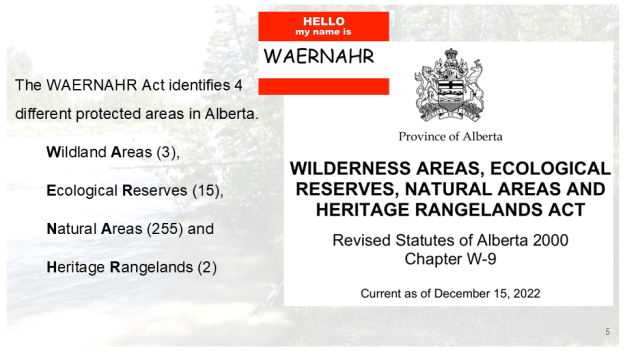
Key Messages
- These sites are SAPAA’s focus.
- SAPAA uses the acronym: “Werner”.
- WAERNAHR provides critical habitat and land bridges for critters & plants.
- There is varying protection across WAERNAHR.
- Sites provide first nature exposure for many families.
Further Reading and Notes
- These protected areas are often small and isolated.
- These sites conserve unique plant, geological, or cultural treasures and provide critical stepping stones for flora and fauna.
- Volunteer stewards registered under the government’s Volunteer Steward Program (begun 1987) have been typically assigned to protected lands covered by the Wilderness Areas, Ecological Reserves, Natural Areas and Heritage Rangelands Act (WAERNAHR Act).
The Good News About WAERNAHR (Slide 8)
Slide Not Presented
- WAERNAHR sites can be used for responsible, low impact recreation.
- Some have amenities, e.g. (North Cooking Lake Natural Area, Wanisan Lake (PNT) Natural Area).
Key Messages
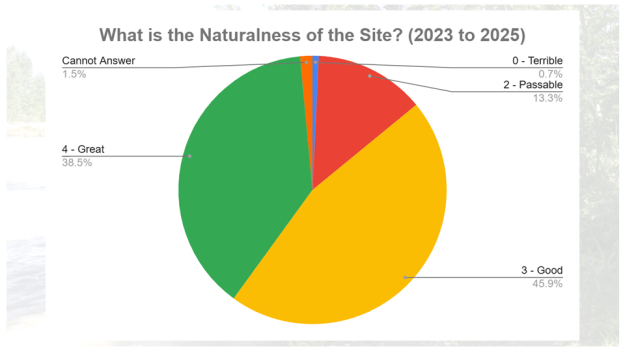
- SAPAA has visited 25% of all Natural Areas.
- Visits were conducted by volunteers, on their own time and expense.
- About 85% are in Good to Great Shape.
- 1 Terrible, Redwater River Natural Area, and a few Passable.
Further Reading and Notes
- SAPAA uses Naturalness to describe a pattern where: A shared natural area is open to many users who gain individually.
- Naturalness refers to the degree to which a protected area retains its native ecological character with minimal human disturbance.
- In the SAPAA context, this typically includes:
- Extent of human-made alterations — trails, structures, vehicle tracks, cutlines, fences, or other developments that reduce the site’s original condition.
- Integrity of native vegetation — whether plant communities remain intact, undisturbed, and representative of the natural ecosystem.
- Presence of invasive species — which reduce naturalness by displacing native flora and altering ecological processes.
- Evidence of ecological processes functioning normally — such as natural regeneration, wildlife activity, and hydrological patterns.
- Overall “wild” character — the degree to which the site feels and functions as an undeveloped natural area.
SAPAA uses this concept to help stewards assess whether a site is maintaining the qualities for which it was originally protected.
- Why naturalness matters in SAPAA’s stewardship model
- It’s a core indicator of ecological health in Alberta’s protected areas.
- It helps identify emerging threats (e.g., off‑highway vehicle use, unauthorized camping, industrial encroachment).
- It guides management recommendations in SIR reports.
Tragedy of the commons (Slide 9)
Key Messages
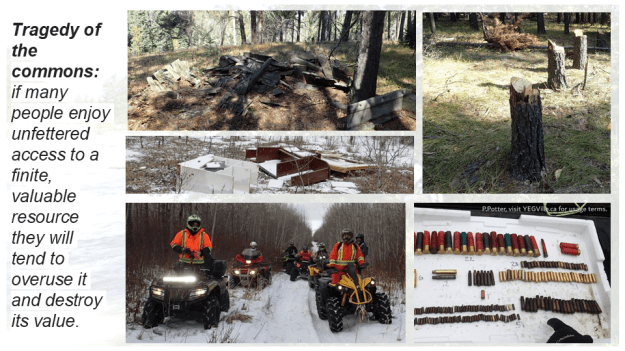
- An economic concept coined in 1833.
- A few individuals who excessively consume to the detriment of others.
- Poster Child: Redwater River Natural Area.
Further Reading and Notes
- The ecological costs are shared by everyone because damage accumulates.
- No single user feels responsible for limiting their own impact.
- The result is long‑term degradation of the protected area’s natural values.
- A variation on this is the Broken windows theory | Wikipedia.
Nearby Residents and Their Concerns (Slide 10)
Key Messages
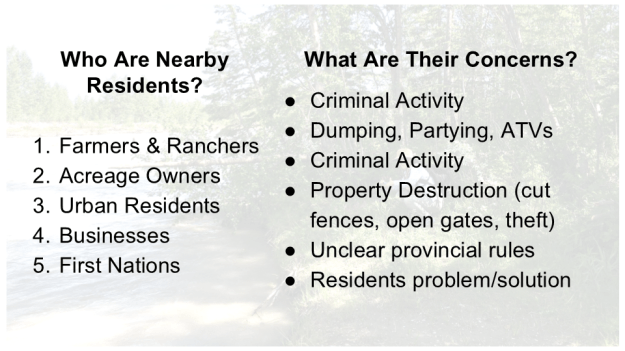
- Rural residents 2X more likely to be a victim of crime.
- Stories from knocking on doors: parties, chopping cars, drug deals, gun ranges, ATV abuse, etc…
- Read trip to Buck Lake Creek NA: one grazing lease holder’s challenges.
Further Reading and Notes
Further Challenges:
- Stewardship capacity is low, meaning no one is monitoring or reporting issues consistently.
- Enforcement is limited, so damaging activities go unchecked.
- Multiple user groups have overlapping or conflicting expectations.
- Industrial pressures (e.g., access roads, seismic lines) accumulate over time.
- Recreation impacts—trail braiding, litter, fire rings, unauthorized camping—compound across seasons.
- SAPAA’s stewardship model (including Site Inspection Reports) is designed to counteract this dynamic by:
- Increasing eyes on the landscape
- Providing structured reporting of impacts
- Encouraging collective responsibility among volunteers, communities, and government partners.
- See a recent interview: Guns, CBC, and Natural Areas – 2024-11-15 | YEG Ville
What is SAPAA Doing to Help WAERNAHR (Slides 11)
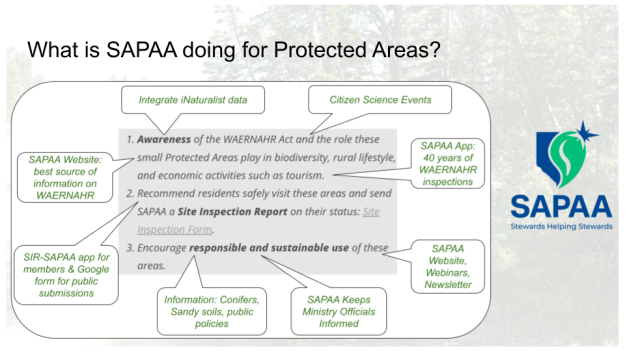
Key Messages
- sapaastewards.com has the best information on WAERNAHR
- SAPAA taken Over Site Inspections from GoA.
- 136 inspections since 2023.
- SAPAA works with GoA.
- Integrating iNaturalist Data
- Community of Practice, sharing expertise.
Further Reading and Notes
- SIR-SAPAA is a Web based site inspection report (SIR) tool launched in 2026.
- All MLAs are invited guests to log into SIR-SAPAA but registration is required: Say Hello to SIR-SAPAA!.
- Comments and feedback to Ministries on public policy and operational activities, for example: Plan for Parks – Public Engagement, and Recent Natural Area Remediation Projects.
- Community of Practice, helping other nonprofits through knowledge sharing: Paddling Toward Stewardship, Best practices in Grant Management (Talking About Grants), the role of Citizen Science in Stewardship (Creating Citizen Stewardship and Citizen [BLANK]), Volunteer Management Systems (The VMS Landscape), OHS Compliance for a nonprofit (Easy Bake Safety)
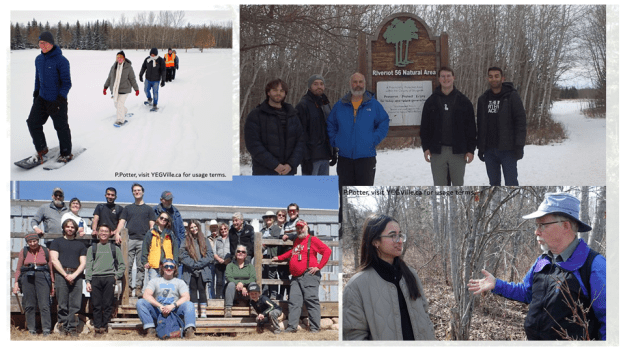
- Hosted nearly 50 students from Alberta and across Canada in Work Experience programs.
How MLAs and Citizens can Help? (Slide 12)
Key Messages
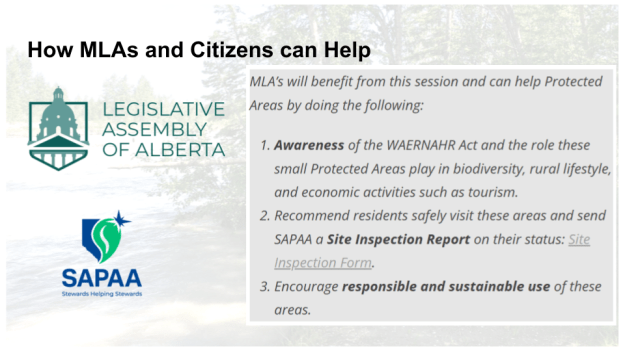
- Objectives 1) awareness.
- 2) Public can send SAPAA a Site Inspection Report.
- 3) Encourage responsible use.
Potential Questions as time permits
- What have learned about WAERNAHR areas?
- Do you have words of wisdom for SAPAA or residents who have questions about a Protected Area?
- How to balance growth and preservation?
- Can we talk about the ATV in the room?
- What is your role as a MLA vis-a-vis the Protected Areas?
Further Reading and Notes
- SAPAA is a tiny organization and so its impact is limited, nevertheless, …
- The stewardship model (including Site Inspection Reports) can counteract the tragedy of the commons by:
- Explaining why protected areas need active stewardship, not just legal designation.
- Highlight systemic causes of degradation.
- Advocate for policy changes, better management, and stronger community involvement.
- Stewardship is a shared duty.
Thank You!
SAPAA is passionate about these often overlooked bits of rural Alberta. Invisible to most people, they are critical for the critters and plants who call the area home. Just as important, they contribute to the clean water and environmental health of local farmers and ranchers as well as support the rural lifestyle.
We know you are very busy, so thank you for attending on March 20, 2026.
MLA’s will benefit from this session and can help Protected Areas by doing the following:
- Awareness of the WAERNAHR Act and the role these small Protected Areas play in biodiversity, rural lifestyle, and economic activities such as tourism.
- Recommend residents safely visit these areas and send SAPAA a Site Inspection Report on their status: Site Inspection Form.
- Encourage responsible and sustainable use of these areas.
 SAPAA
SAPAA 