In this edition: Wagner Natural Area Society looks ahead, Lorne Fitch’s upcoming book, and a SAPAA field trip!
This newsletter can also be downloaded in pdf.

- Editorial
- Renovation of the SAPAA Website
- Looking Back, Looking Forward, in Wagner Natural Area
- Bioblitz in Whitehorse Wildland Provincial Park
- Bioblitz Extended to Cardinal River Headwaters
- SAPAA Site Inspection Form
- September 30 Field Trip
- Good News for Prairie Grassland – McIntyre Ranch Preserved
- Streams of Consequence. Dispatches from the Conservation World, by Lorne Fitch.
- Editorial Team, Links and Resources at a Glance:
- A Few Bonus Pictures!
Editorial
by Patsy Cotterill
We hope everyone is having a busy summer, negotiating the vagaries of the weather and getting plenty of outdoors time!
Website progress… Our big news relates to the SAPAA website; we have finished transferring site information from the old website to the new one, and are now looking to increase its functionality and value with new projects. Frank Potter, our webmaster, has launched a web-based visitor site inspection form with the idea of having stewards and visitors report on site visits to communicate about and foster interest in the natural areas they visit. Frank explains further in his article.
Wagner Society looks to the future…
Wagner Natural Area Society have recently celebrated two major anniversaries as a society and are looking to update their 23-year-old management plan as well as renew their recreational lease. They are seeking public input on the plan by way of a survey accessible on their website.
Stewardship Program proceeding…. The Government is pursuing revamping the Stewardship Program. For example, eight stewards have come forward to take part in a test pilot on citizen science. They will attend a virtual orientation session with government staff on August 30th with the following draft agenda:
- Introductions
- Program overview
- Health & safety
- Inspection form
- Next steps and Questions
And in other news…. SAPAA received a reply from Hon. Rebecca Schulz to a letter of congratulations sent in June. We include a brief news item on the bioblitz that took place in Whitehorse Wildland Park on August 12th-14.th Finally, Amy Tucker, Outreach and Communications Specialist with the Alberta Wilderness Association, gives us a foretaste of wildlife biologist Lorne Fitch’s upcoming book, “Streams of Consequence,” recommending it as a must-read for conservationists and the general public alike.
Renovation of the SAPAA Website
by Hubert Taube
Education and information about Alberta’s Natural Areas are part of SAPAA’s mandate to help protect these areas. The website is a critical tool in this regard. A long-term SAPAA project to update the site was successfully completed by the end of July 2023.
More than 10 years ago, Linda Kershaw created the sapaastewards.com website. Innovative for its time, a PDF file was available for each site along with relevant details. Using a similar format, Frank Potter initiated the updating project in March 2021. Frank as webmaster has been the prime mover for the project, although essentially all SAPAA Board members have been involved in the project at one time or another.
Kristyn Mayner provided an overall description of the various designated provincial protected areas. These designations are in a state of flux and may need updating as time passes, just like all other information on the website.
Chris Smith created the “User Generated Google Map” which shows all Provincial Protected Areas. This map is a unique resource since it provides geographic and legal information on all Protected Areas in Alberta, including all lands covered by the Parks Act (Provincial Parks, Provincial Wildland Parks, Provincial Recreation Areas), the WAERNAHR Act (Wilderness Areas, Ecological Reserves, Natural Areas, Heritage Rangelands) and the Willmore Wilderness Act. Noteworthy is the fact that the map includes areas with OC (order-in-council), PNT (protective notation) and CNT (consultive notation) designation, information that is not readily accessible from government documentation. The map has a useful interactive tool which allows searching for any of the Protected Areas by name.
Finally, we have the individual “pages” for all “SAPAA Areas of Interest” which include 15 ERs (Ecological Reserves), three WAs (Wilderness Areas), two HRs (Heritage Rangelands) and 251 NAs (Natural Areas). (There is some uncertainty in these numbers since designations may have changed or areas may have been delisted.)
For the pages, Frank collected the relevant background information, including geographic, historic, legal, biological and management items. The Government’s Parks website, SAPAA newsletters, general on-line searches, recent observations by members and, of course, Linda’s original SAPAA website of 2012 were the principal sources for the compilation. Frank composed the first draft for each site. Subsequently, each page was edited with the help of Patsy Cotterill and Hubert Taube in nearly weekly sessions over the past two years. The interactive format of the site allows for easy updating of information by authorized SAPAA members and allows the general reader to submit their comments.
We consider this improved documentation as a stepping stone in the renewal of conservation and management initiatives of our Protected Areas. One of the results of this new format, as well as an improved social media presence, is the increase in traffic to the site over the past 22 months (from about 100 views/month to about 500+).

Just about all SAPAA Board members were involved in the project but the bulk of the work was done by Frank to whom we owe a great deal of gratitude.
Looking beyond these pages, the website also provides a platform to interact with members, collect site inspection reports, and be a system of record for changes occurring in the Areas.
Thanks to everybody, Hubert Taube
Looking Back, Looking Forward, in Wagner Natural Area
by Patsy Cotterill

With their fortieth anniversary as a society celebrated last year, and the fortieth anniversary of the completion of the Marl Pond Trail falling this year, the board of the Wagner Natural Area Society (WNAS) has been doing some navel-gazing, with President Dave Ealey in the driver’s seat. The Society’s recreation lease is up for renewal next year and they consider it timely to redo the original, 1999, Management Plan for the Natural Area. There have been plenty of changes since then, and the Society may be at a critical point.
On the website, and in the June/July issue of the Friends of the Fen newsletter, WNAS solicits input on a new plan from interested parties and members of the public via an Online survey; the deadline for submissions is August 31.
A New Management Plan
In his newsletter article “Updating Wagner Natural Area Conservation Planning “as well as on the survey form, Dave outlines the key challenges and opportunities for better management and stewardship of the Natural Area, covering the four themes of (ecological) conservation, education, research and recreation. Parkland County official plans such as its Municipal Development Plan, Environmental Conservation Master Plan and Acheson Industrial Area Structure Plan will also have to be taken into account.
WNAS asks that if you are familiar with the area, or have other experience of stewardship/management issues that you would like to share, please pass on your thoughts and ideas by filling out the survey!

Sunshine, Lollypop Wrappers, and Wagner
Finally, if you have a few hours on September 23, 2023, how about hanging out with some great Wagner folks and help to keep Wagner Wild. Download a Poster.

Bioblitz in Whitehorse Wildland Provincial Park
by Patsy Cotterill
The weekend of July 12-14th saw more than 30 naturalists and researchers of varying interests, expertise and age converge in Cadomin to take part in two days of bioblitzing in Whitehorse Wildland Provincial Park. Their observations and photographs of various organisms have been submitted to iNaturalist and yield the following results to date: 244 plant species, 68 fungi (including lichens), eight mammals, 31 birds, four arachnids and 48 insects, for a total of 404 species and 1,637 observations. Favourite venues in the Park for observations were the East and West Ridges of Cardinal Divide, and Whitehorse Creek trails.
Tara Russell of CPAWS expressed the hope that “the data gathered from the Bioblitz can inform future land use planning for the area and help prioritize conservation of the region.”
The event was organized by CPAWS, the Alberta Wilderness Association, Alberta Native Plant Council, Whitehorse Wildland Provincial Park Stewards, Plant Watch Alberta and the Whiskey Jack Club, with partial funding support from the Alberta Conservation Association.

The WWPP Stewards also took the opportunity to monitor some management concerns as the area has experienced long-time OHV activity and the landscape has been extensively altered by mining and mine reclamation.
A Key Biodiversity Area? A group of us were shown the rare Porsild’s bryum moss, a dark-green, tiny, undistinguished moss clinging to a huge rock in the middle of a busy campground. Its rarity, and possibly that of other species, may be critical in getting the Park designated as a Key Biodiversity Area, with the status and kudos that that entails.

Chris Smith provides the following information on Key Biodiversity Areas:
There are several webinars on the topic hosted by the Wildlife Conservation Society of Canada which are great primers on the issue and can be found here: http://www.kbacanada.org/media/
The current organizational members developing the Canadian KBAs are Wildlife Conservation Society Canada, Bird Studies Canada, NatureServe Canada, Nature Conservancy of Canada, WWF Canada, Nature Canada, the David Suzuki Foundation, the Québec Centre for Biodiversity Science, CPAWS, the Canadian Council on Ecological Areas, and the Pathway to Target 1 National Steering Committee.
Bioblitz Extended to Cardinal River Headwaters
submitted by Kristen Andersen
On August 5th and 6th, a group of five people explored the Cardinal Headwaters trail and surrounding area. The trip was an extension of the bioblitz as the plan to explore more remote areas began during the bioblitz and the goals were similar.
The group explored areas along this heavily used, designated OHV trail that borders the Whitehorse Wildland Park. We visited the Cardinal Falls and several habitats including a large area of limestone pavement with a series of waterfalls.
On August 7th, three members of the group who had stayed an additional day hiked up a bowl on the north side of Mount Cardinal.
Goals of the trip were to document rare plants, learn more about the vascular plants, bryophytes and lichens in this special area, and document the progression of tire ruts and related damage from OHV traffic, including encroachment by OHVs into the adjacent Whitehorse Wildland Park. OHV damage and encroachment were confirmed and documented for recording in the stewardship report.
SAPAA Site Inspection Form
by Frank Potter
Good Data is Central to Good Science. For Stewards, how a Natural Area has changed over time and/or timely reporting of problems helps to keep the sites healthy and accessible to all. SAPAA is piloting its own site inspection form. Based on the government’s online version, it is intended to collect better and more relevant data. Most importantly, the data collected will be held by SAPAA for member use (and within the constraints of privacy expectations).
Anyone Can Submit using the form but they must first be registered and have a Google Mail (GMail) account. The GMail requirement helps to keep the form secure and data relevant. Once registered, you can submit for any of the Natural Areas and as many times as you like.
Prototype and Government Submission. The current form will be used until December 2023 after which the data and the lessons learned will be shared with the government. Your feedback is critical to keeping the form relevant and useful.
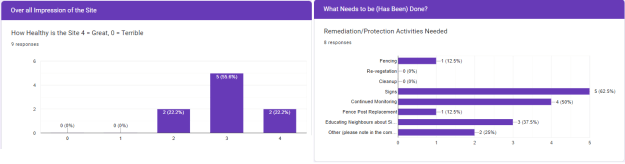
Interested? Send an email to webmaster@sapaastewards.com and Frank will get you started. Want to learn more first? Visit Frank’s two blogs on the topic: Looking for a Few Good Reports and Site Inspection Form – Trust but Verify.
September 30 Field Trip
by Frank Potter
Edmonton Capital Region. I will organize a field trip for September 30, 2023 in the Edmonton Area. This is the first one in a few years but the board is interested in hosting more in the near future.
Let’s Go – September 30 or the Future. Whether you can make the September 30 trip or not, please complete the following survey. It will help the board measure interest in field trips, where to go and activities once there. This survey will close on October 15, 2023.
September 30 AND Future Field Trip Surveys.

Good News for Prairie Grassland – McIntyre Ranch Preserved
submitted by George Shaw
The Thrall family has long operated the McIntyre Ranch in southern Alberta in a careful, sustainable way but now it has gone a step further towards protecting it in perpetuity by negotiating a conservation easement with the Nature Conservancy of Canada Land Trust and Ducks Unlimited Canada. This will ensure that this 22,000-ha area of native grassland, home to 33 species at risk, will remain “healthy, natural and in an unfragmented state in the long term.” This is the largest private conservation easement in Canadian history.

Streams of Consequence. Dispatches from the Conservation World, by Lorne Fitch.
Rocky Mountain Books. 2023. (publication date: October 2023)
Review by Amy Tucker, Outreach and Communications Specialist, Alberta Wilderness Association
Are you open enough and willing to dive into the disappointing truth of Alberta’s past that has sent the wilderness — and us — barreling down a path of no return (if we’re not willing to change our ways)? Moreover, can you pay heed to the words of caution from a retired Alberta Fish and Wildlife biologist, stitched together in a 200-paged, well-packed book?
Admittedly, this seemed like a daunting task at the start for someone like me, who does not have a background in science or conservation, but it also felt vital to read on. And author Lorne Fitch made it easy to do so in his new Streams of Consequence, set to hit store shelves in October. His thoughtful and evocative quilt of essays (which are perfectly stitched together) was an accessible window into the mind and memories of a long-time biologist. It’s a good read for conservation-minded folks and it should be mandatory for those of us still learning the details of how we got to this climate crisis.
So, if you are willing to understand the conservation issues plaguing Alberta starting from at least a century ago — and which are now coming to a head — Streams of Consequence will do that.

Readers are guided along, using a narrative reminiscent of a stream of consciousness, through Fitch’s early days growing up in central Alberta, his first encounters with wetlands, his adoring memory of trout “floating” in crystal clear waters. The reader isn’t just pulled along with him on the journeys, but through space and time so that it’s like you’re sitting there with him as a young boy using aspen logs as a raft getting your feet wet with him, or discovering the inhabitants of a nearby pond near his childhood home. He does this while weaving in the plights of species on the brink, both adored by Albertans (grizzly bears and caribou among them) and of ones that are often unknown or forgotten about by the masses like Short horned Lizards, Rough Fescue, native trout, Norther Leopard Frogs and Sage Grouse. He builds up an infectious sense of love for these creatures (our cousins, as he describes them) and the places they call home.
The tone is careful when placing the blame: instead of pointing fingers at one cause, company or group, through storytelling, Fitch shows how multiple events, and not enough (or sometimes too much) government intervention, have led to a fragmented and broken environment.
He also doesn’t leave the reader with a message of doom. Moreover, he offers hope, as when discussing the protection and recovery of caribou populations. “Hard but not impossible choices must be made.” And he gives advice — and a warning to the current and coming generations. “We have begun to appreciate the consequences of our actions, many unintended. What is more disturbing, even perplexing, is that it all could have been avoided.” The future can still be written, he implores later on, and we have the pen.
For newcomers and young people, especially, who don’t have memories of a previously wilder Alberta, Fitch seems to hold up a rear-view mirror of the province’s past (from a settler’s perspective). Caution: actions and events that led to the catastrophic destruction of our natural landscape are closer than they appear. And, he nails up a sign. Warning: Best road forward is pockmarked with craters. The easy, scenic route leads to a cliff.
Streams of Consequence is a book that should be taken as not just a history lesson but a beacon of much needed hope. In a time where climate anxiety is high and apathy because of it is common, it’s just what we need.
Lorne grew up on a mixed farm in west-central Alberta. He left the farm but the experience of growing up in semi-wild circumstances never left him. He has been a biologist for over 40 years, working mostly in Alberta but also in other parts of Canada and with some international experience.
For his work on conservation he has received an Alberta Emerald Award and has been part of two additional Emerald awards. His work on effectively communicating science has been recognized by The Wildlife Society, the Society for Range Management and the Alberta Society of Professional Biologists.
Biography courtesy of The Nature Conservancy of Canada. To learn more, read this excellent AWA biography from 2015.

Editorial Team, Links and Resources at a Glance:
Editorial team: Patsy Cotterill, Frank Potter, Hubert Taube.
- List of Alberta’s Protected Areas.
- Connect & Read.
- Online Steward Reporting form.
- New and Renewal of SAPAA Membership.
- SAPAA’s FaceBook Group.
- Land Reference Manual | Alberta Parks.
- This Newsletter can downloaded in pdf.
A Few Bonus Pictures!
 SAPAA
SAPAA 