A recap of SAPAA’s November 2024 AGM, board updates, and the recent CBC story on the legacy Volunteer Stewardship Program. A natural history segment features Alberta’s coniferous trees and ongoing conservation news regarding environmental policies. This newsletter can also be downloaded in pdf.

- Editorial – A belated Happy New Year to all our readers!
- CBC News Story: “Volunteer stewards still monitoring natural areas years after government program faded”
- The Miistakis Report – Much Ado…
- Getting to Know Alberta’s Coniferous Trees
- Other Conservation News
- Membership
- Editorial Team, Links and Resources at a Glance:
- A Few Bonus Pictures!
Editorial – A belated Happy New Year to all our readers!
by Patsy Cotterill
In this issue, we do a quick review of changes initiated at the Annual General Meeting of SAPAA on November 30, document the serendipitous spotlighting of the Volunteer Steward Program and SAPAA through a CBC Edmonton News program and, finally, are able to summarize some of the salient points made in the newly released Miistakis Institute Report on the steward program.
For our natural history segment, we invite readers to take a look at a piece on Alberta conifers. As always, we invite reader input and feedback. Best wishes for 2025! As always, we invite photos, comments and contributions from our members/ readers. To contribute, please email me at secretary@sapaastewards.com.
SAPAA AGM 2024 and beyond…. Board Update
by Patsy Cotterill
On November 30, 2024, SAPAA held its Annual General Meeting and successfully reconstituted its board, with Frank Potter replacing Hubert Taube as president (see Contact Us for board biographies).
Hubert moved to newly created role of past-president and also becoming a director. Myrna Peters and Patsy Cotterill continue as treasurer and secretary respectively. Appointed directors are David Fielder, Madeline Mayes, Tony Blake and, Chris Smith.
Chris, who resides in The Maritimes, has since resigned after performing the important task of transferring ownership of the site maps on the website to Frank and solving some of the technological challenges associated with it. SAPAA is extremely grateful for the important contribution he has made to the website with the maps.
Thank You Hubert
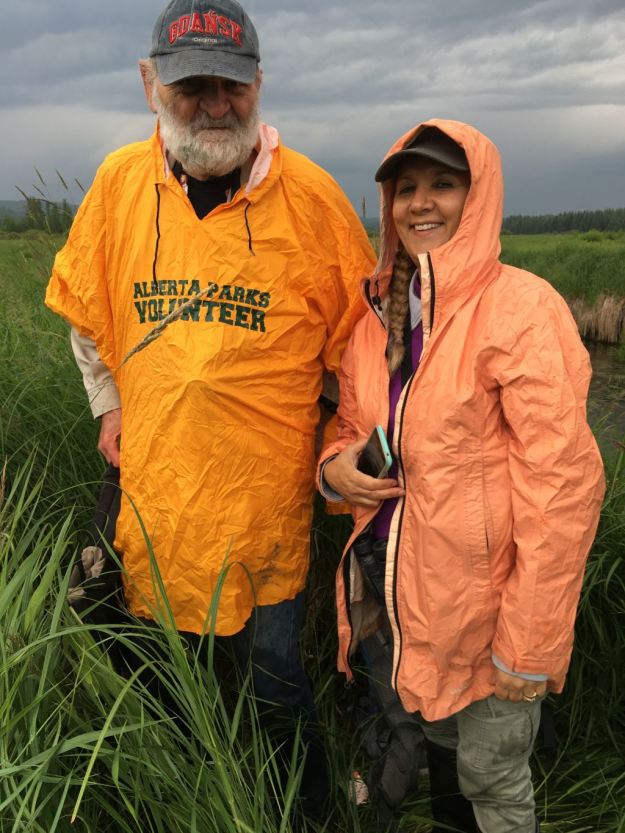
Following the election, Patsy gave a tribute to Hubert for his years of service to SAPAA. He has been president for the eight years since 2015, and vice-president for 10 years before that, performing all the duties that these positions entail. Patsy noted that Hubert is stepping back but not away…
Citizen Science in Alberta
Prior to the business meeting of the AGM, Kristyn Mayner, a staff member of the government’s Office of the Chief Scientist, gave a presentation on the Citizen Science Alberta Community of Practice.
Formed in 2015, it is run by a committee of people with environmental interests and maintains a website (citscialberta.com), with the aim of sharing “ideas and information for enhancing design, delivery and evaluation of citizen science projects.”
According to this website, “ AEP [now the Department of Environment and Protected Areas, EPA] and the Miistakis Institute, with guidance and input from citizen science practitioners and researchers at the workshop (held 2018), co-developed the Citizen Science Principles of Good Practice.” The principles, along with a project catalogue, and an invitation to add projects to the directory, are on the website.
SAPAA Comment: Given the involvement of the Office of the Chief Scientist (EPA) in this project, especially as an initiator, it is clear to SAPAA that the government wishes to make use of citizens in gathering ecological and other data related to environmental management of its Protected Areas. It provides greater clarity as to why, in looking to re-envision the Volunteer Steward Program, in conjunction with the Miistakis Institute, there should be an emphasis on exploring the potential of citizen science.
However, so far, we have no information on whether the government is making progress with incorporating citizen science into a revived program that would involve volunteer stewards. For the present, it seems to be encouraging citizen science by the means of the Community of Practice.
Currently, SAPAA seeks to serve the “eyes and ears” function of the erstwhile Volunteer Steward Program with its site inspection forms, but to what extent could it satisfy a citizen science function having more stringent, scientific data-collecting requirements?
Should SAPAA initiate projects? The Miistakis Institute report observes that data collected must be of sound scientific value for conservation purposes. Such data collected by stewards could have the dual purpose of assuring them that their investments are of value.
SAPAA further notes, with respect to the citsciAB website, that it is not clear how projects are vetted for scientific probity. At the aforementioned conference last Fall, Frank Potter presented the concept of ‘Citizen Stewardship’. In addition to panel discussion on what SAPAA is doing, a 60 second video was also requested:
And beyond….
The board has hit the ground running working on the 10 priorities approved by the members at the AGM (see Newsletter 52). The Board has expanded and defined the work (see below for Frank’s article on some of these details).
While our immediate priority is the current site inspection form and reporting technique to achieve a final workable product, we have a number of projects on the go. We are supported in these priorities with youthful enthusiasm from the University of Alberta’s Community Service-Learning program. A new director, Madeline Mayes, was recruited in this way and we are very happy to welcome her.
Three students selected SAPAA over two other organizations. To help in their selection, the students could access a Post and a YouTube video explaining the projects.
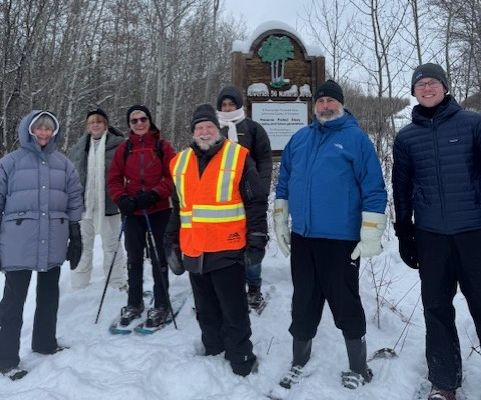
Central to SAPAA’s student project strategy is taking them to one or more of Alberta’s Natural Areas. In December, SAPAA introduced snowshoeing to last semesters students and introduced them to long time Riverlot 56 stewards George and Mary Binette.
We are now using Google Workspace for our internal communications and the Board is experimenting with technology to make SAPAA’s functioning more efficient. For example, access to historical site inspection reports and a photo library is on the horizon as part of strategic priorities.
Want to Help? Build, Report, Learn, and have FUN?
As always, we look to our stewards and the interested public to help us out in making site visits and filling in as many site inspection forms as possible. Contact Frank, president@sapaastewards.com if you want to help out.
The Board’s objective is for SAPAA to become a credible replacement for the government’s volunteer steward program. Buckle your seat belts, SAPAA board, we are in for quite a ride!
CBC News Story: “Volunteer stewards still monitoring natural areas years after government program faded”
by Patsy Cotterill
The Volunteer Steward Program (VSP) and SAPAA came under the spotlight early in the New Year thanks to some investigative journalism by Madeleine Cummings of CBC Edmonton News. For a story which aired on January 4th, she interviewed stewards, paid field visits in the company of stewards and contacted the Ministry of Forestry and Parks and academic interests. She also obtained by FOIP the elusive Miistakis Report on the VSP which had not been released to SAPAA despite our requests.
During a visit to Redwater River Natural Area, SAPAA’s Frank Potter showed the results of excavating about four square feet of an illegal shooting range. Madeline was given an early Christmas present of 175 spent shell casings (5 live shells were turned into a local RCMP detachment). By extrapolation, it is estimated there are about 50,000 spent shells, about 500 live rounds, and 13 kg of lead in a nearby wet area. To read (and critique the estimates, please!) visit: Guns, CBC, and Natural Areas – 2024-11-15 | YEG Ville.
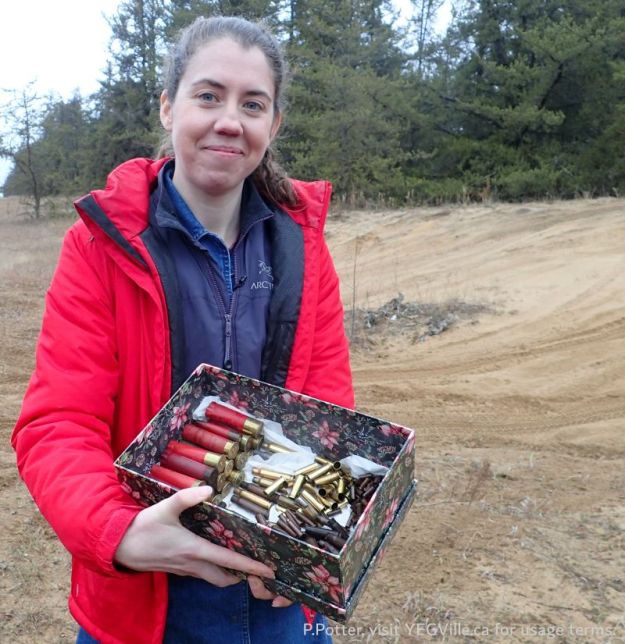
The damage to this Natural Area is problematic as this sand dune area is home to a substantial population of sand heather. A relatively rare species which grows in the sandy soils in north and central Alberta. It is disturbed when ATVs create bare sand and erosion.
The field tour started at Halfmoon Lake Natural Area where long-time stewards Richard and Vera DeSmet, along with other members of the Rainbow Equitation Society, guided a tour of trails and explained how they had taken advantage of the provincial government’s trails policy and associated funding to maintain them.
The Big Lake Environmental Support Society is another example of a legacy steward organization that is going it alone. Al Henry and Miles Constable of BLESS demonstrated the new QR code system they use to invite visitors to provide feedback on trails around Big Lake.
Various comments from interviewed stewards made it into the CBC report. Dr. Guy Swinnerton, a legacy steward of Hastings Lake Islands Natural Area, expressed disillusionment with the VSP and the government’s failure to communicate with stewards.
Roving steward Tony Blake expressed his hope that “a renewed program has a purpose that fits into a larger conservation objective.” Frank Potter said he “would like to see the government create and partially fund a new consortium to run it (the VSP) in the future. In the meantime, SAPAA will continue building its own stewardship activities.” Unfortunately, President of Wagner Natural Area Society Dave Ealey’s planned CBC radio interview was pre-empted by the announcement of the Prime Minister’s resignation.
A spokesperson for the Ministry of Forestry and Parks assured Cummings that the government intends to “re-establish the program, updating operations, processes and protocols to align with changes to federal and provincial programs.”
The government is using recommendations outlined in the report it commissioned by the Miistakis Institute on the state and future of the VSP. A pilot was initiated in 2023. A select number of stewards was interviewed on-site regarding the feasibility of implementing citizen science projects. Stewards have not been informed of further progress since then (See The Miistakis Report – What Did We Learn?).
The government is also supporting a “science hub” (see the report on the presentation by Kristyn Mayner in the SAPAA AGM minutes of November 30.)
The full story can be accessed via CBC Story – Volunteer Stewardship Program.
SAPAA would like to thank Madeleine Cummings and the CBC for a well-researched and -presented report which throws much-needed light on the situation of Alberta’s government stewards and the natural areas they look after.
The Miistakis Report – Much Ado…
Patsy Cotterill analyzed and reported on the elusive Miistakis Report. Written with tongue firmly planted in our cheek, SAPAA has been requesting a copy for two years. Thanks to Madeline Cummings and CBC, a FOIP request revealed the report secrecy was… much ado about nothing.
Read Patsy’s full analysis with relevant slides from her January 30, 2025, presentation.
Getting to Know Alberta’s Coniferous Trees
Edited by Frank Potter
Do you know your white spruce from black? How about larch versus tamarack? Whether you are an expert or non-botanist (full disclosure, that is me), you will enjoy Patsy’s article on identifying Alberta’s conifers. This is the first of hopefully a series on natural history topics to help educate our members and public of what exactly are in the Natural Areas.
Other Conservation News
SAPAA works within the context of the larger conservation question. The following have come to us and we are passing them on to our members. Whether you are in support (or not) of the following, SAPAA believes in respectful civil discourse.
Coal-mining in Alberta
Environmentalists are opposing recent government actions to allow coal mining to be resumed in the Eastern Slopes, reversing a policy designed to protect this area from development. They want the public at large to join them in opposition. Click on the links below to find letters developed by the Alberta Wilderness Association and the Canadian Parks and Wilderness Society that you can sign and submit, and/or find out more about these issues.
“Wolverines: the latest victims of unsound policy”
Richard Schneider, writing in the Winter 2025 issue of Nature Alberta, on the government’s ‘wacky decision’ to assess the numbers of wolverines in the province by trapping them, has this to say:
What we are witnessing is a disconnect in governance. The current government is focused on serving a small subset of Albertans rather than the broad public interest, more so than any previous government. The public has also become disconnected. The erosion of environmental protection has advanced piecemeal, flying under the radar of most Albertans. The current political spotlight is dominated by social and economic issues and when it comes to the environment, the main focus is climate change.
It is unlikely that matters will improve unto the public becomes aware of what has been happening and holds the government to account.
He concludes with a request to the public to extend the protest by writing to Minister of Forestry and Parks Todd Loewen at fp.minister@gov.ab.ca and Premier Danielle Smith at premier@gov.ab.ca.
Membership
Annual membership renewal remains at $15 per individual, family or group steward and includes a $5 insurance fee the society pays to Nature Alberta.
E-transfers are preferred (treasurer@sapaastewards.com) but if payment is made by cheque, it should be made payable to Stewards of Alberta’s Protected Areas Association (in full, the bank is persnickety) to c/o Patsy Cotterill, Membership Secretary, 7401 156 Street NW, Edmonton, AB T5R 1X4.
The membership year runs from October 1 to September 30. If you have changes to make to your information or wish to provide additional information, please provide updates by completing and emailing /mailing the Membership Form available on the Home Page.
Thank you.
Editorial Team, Links and Resources at a Glance:
Editorial team: Patsy Cotterill, Frank Potter, Hubert Taube.
- List of Alberta’s Protected Areas.
- Connect & Read.
- Online Steward Reporting form.
- New and Renewal of SAPAA Membership.
- SAPAA’s FaceBook Group.
- Land Reference Manual | Alberta Parks.
- This Newsletter can be downloaded in pdf.
A Few Bonus Pictures!
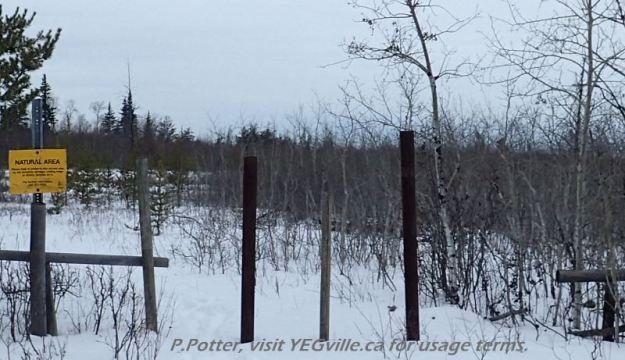
Southeast entrance, at the end of RR 225, to Opal NA, 2024-03-09, P. Potter. 
Fungus on a birch tree, Halfway Lake Natural Area, 2024-04-06, P. Potter. 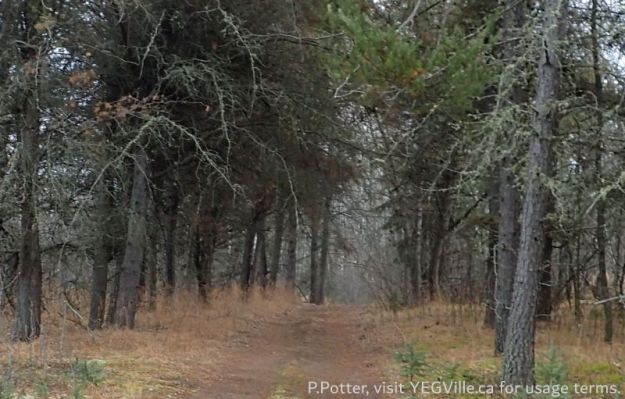
ATV track heading East into the site, Halfway Lake Natural Area, 2024-04-06, P. Potter. 
Despite shedding its needs, this Tamarac Tree still retains snow very well, Halfway Lake NA – South, 2024-12-29, P. Potter. 
Heading East through a ‘winter wonderland’, Halfway Lake NA – South, 2024-12-29, P. Potter.
 SAPAA
SAPAA 