The status of fungal pathogens in the development of biological control programmes for Canada thistle, Cirsium arvense, in Canada, with particular reference to Canada thistle rust fungus, Puccinia suaveolens (Persoon) Rostrup (formerly Puccinia punctiformis). You can also download the article.
Update Sept 5, 2025: Chris has provided an updated version of this article.
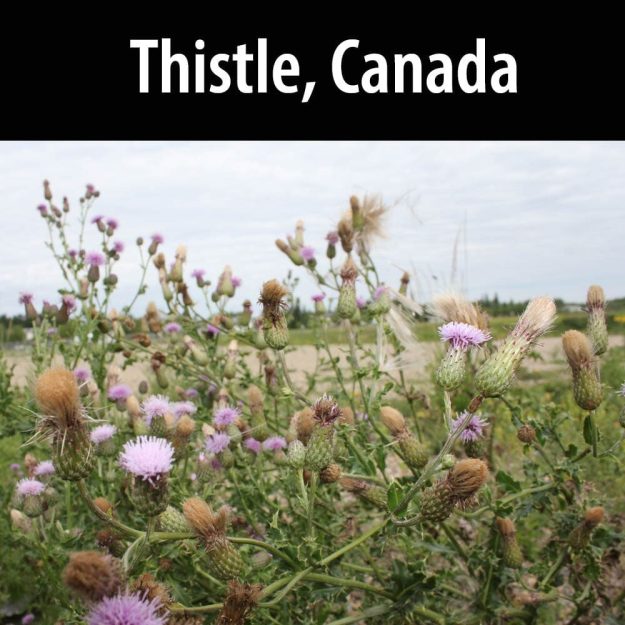
- Understanding the Pathogen’s Life Cycle is Key to Biological Control
- Natural Cycle for Systemic Disease of Thistle Rust in CT
- Colorado Dept. of Agriculture’s Thistle Rust Biological Control Program for Canada Thistle
- Local Trials: Adaptation to Alberta Conditions. Improvements to the CDA Protocol for Inoculation and Plans for 2025
- Thistle Rust Establishment Results from Colorado
- Canada Thistle’s Immune System against Microbial Pathogens and Insect Herbivores
- The Endophyte Bacterium Pseudomonas poae – a CT symbiont and Fungal Antagonist
- The Soil Fungus Phoma macrostoma causes White Tip Disease of CT
- Development of the Canadian Bioherbicide Phoma macrostoma 94-44B
- Acknowledgements
- References
Canada thistle is one of the most problematic weeds of crops, pastures, range lands, natural areas and riparian habitats throughout North America. Canada thistle rust fungus, also known as thistle rust, is a fungal pathogen that only infects Canada thistle (CT). Both the thistle and the thistle rust were introduced to North America as settlers began arriving from Europe more than 400 years ago [1]. Today, both species have naturalized throughout most of the USA and all Canadian provinces. Recent investigations by Bradshaw et al. (2022) [2] into the genetic diversity of thistle rust populations in North America discovered only three of the 11 haplotypes that exist in its native European range.
Understanding the Pathogen’s Life Cycle is Key to Biological Control
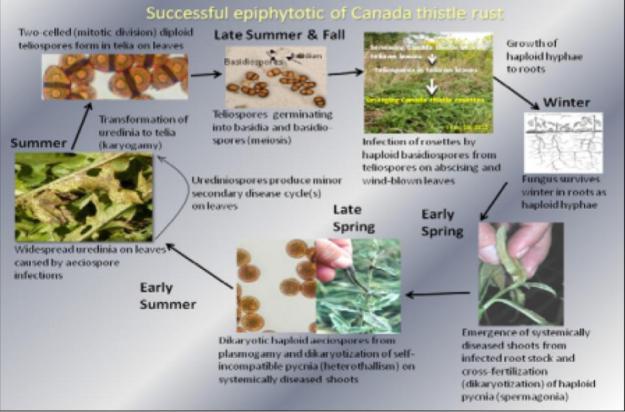
Naturalized thistle rust infections cause systemic disease in CT, which annually reduces the stem density of a thistle patch and eventually kills the entire thistle clone’s rhizome [3]. By 1893, thistle rust was proposed as a biological control agent for CT, but an incomplete understanding of the complex life cycle preventing reliable establishment of epiphytotics (outbreaks) of the disease persisted for another 120 years. Then Berner et al. [3] published the systemic disease cycle in 2013. This enabled fall harvesting of thistle rust teliospores as the biocontrol agent, with artificial transfer of the disease from a naturally occurring infection to the surface of thistle rosettes of a disease-free thistle clone. Under appropriate weather conditions the teliospores will germinate into basidiospores which then enter the rosette and produce a germ tube that grows down the stem into the root and finally into the thistle rhizome where it overwinters and becomes the initial disease infection.
Natural Cycle for Systemic Disease of Thistle Rust in CT
[IMAGE]
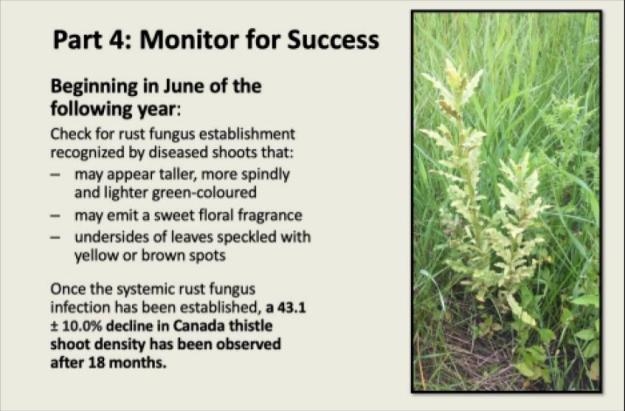
Based on 10 sites inoculated between 2008 and 2012 in Russia, Greece and the USA, Berner et al. (2015) [4] demonstrated thistle rust inoculation to cause an average reduction in CT stem density of 43.1% ± 10.0% at 18 months post inoculation; 63.8% ± 8.0% at 30 months; and 80.9% ± 16.5% at 42 months [4]. In the same study, besides the normal symptoms of systemically diseased shoots observed the following spring, they also reported asymptomatic rosettes at locations adjacent to the previous fall’s inoculation points [4]. The asymptomatic rosettes did not show the regular symptoms of systemic infection but were stunted and appeared to be diseased [4]. Testing for the disease in the roots of asymptomatic rosettes showed that 50-60% had root infections of thistle rust [4].
Colorado Dept. of Agriculture’s Thistle Rust Biological Control Program for Canada Thistle
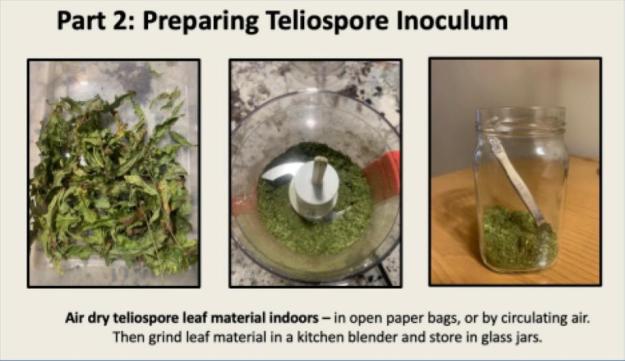
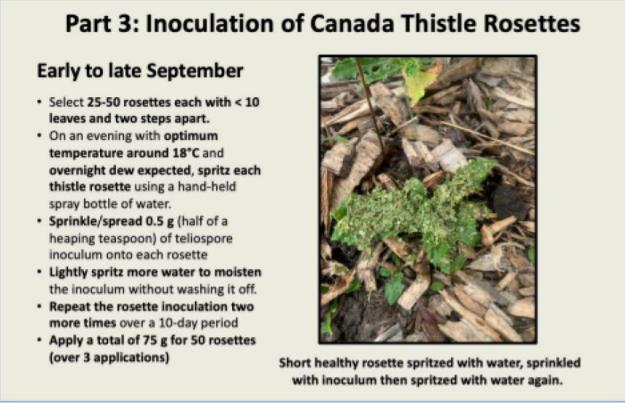
In 2013, the Colorado Department of Agriculture (CDA) substituted its insect-based biological control program for CT with a thistle rust fungus-based program (K. Rosen, pers. comm.). This new program provided farmers, ranchers and weed management professionals with 75g of rust fungus inoculum to establish new infections of thistle rust in disease-free infestations of CT on their land. Guidance on the inoculation process was provided by the CDA’s Thistle Rust Fungus Inoculation Protocol Using Teliospores (K. Rosen, pers. comm.). By 2020, the CDA’s Thistle Rust Bio Control Program had ramped up its sales to 420 x 75g inoculum packages for a total of 31.5 kg. This amount of inoculum was mostly harvested from several four to 10 hectare-sized natural infections of thistle rust that supplied both Colorado State and out-of-state cooperators (K. Rosen, pers. comm.).
Colorado Dept. of Agriculture’s Thistle Rust Inoculation Protocol Using Teliospores
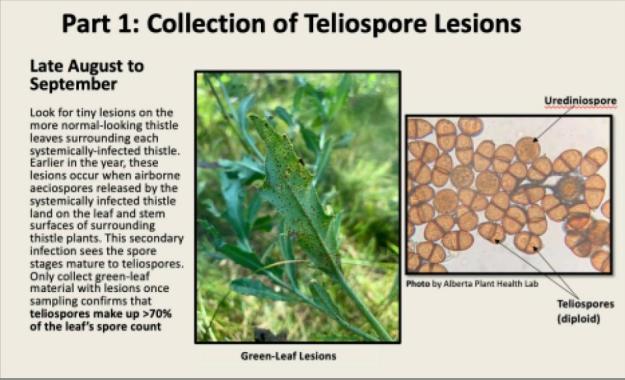
Local Trials: Adaptation to Alberta Conditions. Improvements to the CDA Protocol for Inoculation and Plans for 2025
Some larger, naturally occurring thistle rust infections have been discovered in Edmonton’s North Saskatchewan River Valley at Hermitage Park, downwind of a lake in Elk Island National Park and along a treeline close to wetlands in the Wagner Natural Area. These natural inoculum sources have enabled trials to successfully spread thistle rust fungus to disease-free CT patches since 2020.
To improve on a general lack of naturally occurring thistle rosettes at fall inoculation sites, the sites can either be mowed to the ground or the thistle stems pulled four to six weeks prior to the planned inoculation date. This will prepare the site with a patch of new rosettes that will increase the likelihood of infection success.
Over the past four to five years, the City of Edmonton’s Pest Management Lab has greatly improved on the CDA’s original thistle rust inoculation protocol for teliospores. It has advanced from a targeted hand application of 0.5g of ground leaf teliospore inoculum per rosette to a broadcast application by backpack sprayer of a water-based suspension of finely screened, ground leaf teliospore inoculum, over areas of thistle infestation. This broadcast method has shown some good success in terms of improved inoculation rates and thistle stem density reduction, as well as benefits like a more standardized approach to teliospore application rates. Using a cell counter and measures such as teliospores/ml., a dilution factor can be applied to achieve a certain teliospore application rate (C. Pelletier, pers. comm.).
2025 plans to investigate the success of fall 2024’s inoculation sites in the Edmonton area will include searching for above-ground asymptomatic CT shoots. Hopefully, the availability of PCR testing at the Alberta Plant Health Lab for the presence of a) thistle rust in the roots of asymptomatic CT shoots, and b) the presence of bacterial endophytes in the corresponding shoot portion of each sample may shed more light onto the cause behind above-ground asymptomatic shoots of CT.
A summer 2025 initiative is to train County and Municipal District Agricultural Field staff to begin looking for natural thistle rust infections and to locate and document any they find. This could see the beginnings of County and Municipal District inventories of thistle rust collection sites.
Thistle Rust Establishment Results from Colorado
Colorado’s statewide biological control program for CT was suspended by USEPA in 2022. Subsequently Bean et al. (2024) [5] published their analysis of population data for the first eight years (2014-2021) of CDA’s thistle rust biocontrol program for CT. This included data from 87 CT sites treated with the naturalized thistle rust fungus. They concluded that at approximately 77% of the 87 inoculation sites, stem densities of CT declined over the study period [5]. However, only 17% of treated sites showed above-ground signs of infection. This means 83% of treated sites were asymptomatic above ground or were not infected, yet the rust fungus was still reducing the stem density of the clone through spread of infection in the root system. Bean et al. [5] also determined that:
- Stem density declines were similar the closer they were to each other. This was likely attributable to local climatic conditions. Therefore, growing conditions could be important predictors of CT decline.
- The amount of inoculum use, the timing since the last inoculation and the method of inoculation were also associated with the magnitude of CT stem decline.
- Broadcasting spores over areas with CT infestation may result in better infection rates and impact.
- A broadcast method would be easier for implementation by farmers and ranchers.
Canada Thistle’s Immune System against Microbial Pathogens and Insect Herbivores
While environmental conditions such as weather may affect successful rust inoculation, CT’s natural defence systems undoubtedly play a large role. Besides the prickly leaves that ward off larger herbivores CT, like most vascular and non-vascular plants, has an immune system using salicylic acid and jasmonic acid hormones. The immune system functions through a sophisticated array of antimicrobial defense mechanisms that specifically target an invasion of the thistle by pathogenic fungi or bacteria, triggered by the release of salicylic acid. Similarly, an arsenal of antifeedants, insecticides, etc., is all triggered by the release of jasmonic acid on detection of a feeding attack by herbivorous arthropods. When a teliospore germinates on the surface of a CT rosette it produces basidiospores that then penetrate the surface tissues of the thistle rosette. The rosette would then respond with rapid synthesis of salicylic acid that activates a variety of antimicrobial responses by CT. These include the hardening of cell walls to resist penetration, affecting the virulence of opportunistic pathogens, etc. However, the two hormones, jasmonic acid and salicylic acid, are mutually exclusive, so when one of the hormones is released, the other is suppressed. This allowed Clark et al. [6] to use jasmonic acid to simulate increased herbivory pressure during the teliospore inoculation of CT seedlings in a greenhouse experiment. This should have inactivated any thistle defenses against teliospore inoculation. Here’s what they found:
- An increase in basidiospore infection rates by almost 20% over controls,
- A consistent reduction in CT root biomass by 45% over controls.
The Endophyte Bacterium Pseudomonas poae – a CT symbiont and Fungal Antagonist
Kentjens et al. (2023) [7] suggest that problems with thistle rust establishment and control of CT may be attributable to different thistle endophyte populations in various environments. Pseudomonas poae is a bacterium that colonizes the endosphere of above-ground parts of CT where a number of endophyte communities exist [7]. Different strains of P. poae are known to demonstrate a symbiotic relationship with CT, protecting it from abiotic stressors, such as:
- Low nitrogen and phosphate nutrient levels – by carrying genes for biological nitrogen fixation and by enhancing uptake of phosphate through the solubilization of soil phosphate [7].
- Iron deficiency – through the production of siderophores that secrete secondary metabolites capable of chelating iron [7].
- plant hormone deficiencies – by synthesizing plant hormones such as indole acetic acid (IAA), the auxin that regulates growth and developmental processes such as cell division and elongation, apical dominance and responses to light, gravity and pathogens [7].
In a study of the antagonistic relationship between P. poae strain CO and Fusarium Seedling Blight (FSB), Ibrahim et al. (2023) [8] demonstrated that wheat seed treatments with P. poae strain CO inhibited spore germination, germ tube length and mycelial growth, and reduced FSB mycotoxin production by between 51.33% and 87.00% compared to controls. Furthermore, wheat seedlings treated with P. poae strain CO caused a) root and shoot lengths to increase by ~33% over controls, and b) both fresh and dry weights of shoots and roots to increase by ~50% over controls [8].
The Soil Fungus Phoma macrostoma causes White Tip Disease of CT
Ibrahim et al.’s study [8] relates to the 2020 identification of P. poae in CT infections of the soil fungus, Phoma macrostoma, a recent new arrival in Bunchberry Meadows Conservation Area (J. Feng , pers. comm.). It seems likely that P. poae should oppose the P. macrostoma infection in its CT host; however, it’s entirely possible that this was a less virulent strain of P. poae, or that the novelty of the situation may have impaired the effectiveness of the endophyte. The widespread outbreak of white tip disease in CT throughout central Alberta in 2019 (McClay and Saunders (2024) [9]) has persisted now for the past six years and consists of the wild form of P. macrostoma 94-44B, along with several other of its strains (K. Bailey, pers. comm.).
Development of the Canadian Bioherbicide Phoma macrostoma 94-44B
Strain 94-44B was selected for its higher toxin potency and successfully developed into a registered bioherbicide in Canada at the Saskatoon Research Station (AAFC) in 2011 (Bailey and Falk, 2011 [10]). P. macrostoma comes with a very well researched understanding of its biology and mode of infection in CT. Bailey et al. (2011) [11] discovered that the fungal mycelium of P. macrostoma colonizes the root systems of many dicotyledenous plants. However, in susceptible hosts like CT, P. macrostoma further colonizes the root hairs [11]. Any surface damage to the root hairs opens a pathway for the P. macrostoma mycelium to penetrate inside the root hair and into the vascular system of the thistle root [11]. Presumably, from there the mycelium grows upwards to the apical meristem, where the pathogen’s toxins completely shut down chlorophyll production in new growth resulting in the characteristic symptom of infection known as ‘apical photobleaching’.
While white tip disease resulting from Phoma macrostoma 94-44B mycoherbicide treatment could have proven to be an effective biocontrol agent for both Canada thistle and dandelion (Taraxacum officinale), unfortunately, there has yet been no commercialization of the bioherbicide. This is mainly due to the lack of an economically viable method to mass produce Phoma macrostoma 94-44B (K. Bailey, pers.comm.).
Acknowledgements
Much gratitude is expressed to:
- Jie Feng, Lead
- Qixing Zhou, Research Scientist
- Heting Fu, Research Technologist
- Alberta Plant Health Laboratory, AB Agriculture, Forestry & Rural Economic Development
- For molecular and morphological identification of C. arvense pathogens and Pseudomonas poae, a bacterial endophyte and biological control agent for white tip disease and thistle rust fungus in Canada thistle.
- Karen L. Bailey, Research Scientist (retired)
- Agriculture and Agrifood Canada, Saskatoon, SK
- For providing information on wild strains of Phoma macrostoma and the status of commercial production of Phoma macrostoma strain 94-44B bioherbicide.
- Karen Rosen, Biocontrol Specialist, and Project Leader for the Thistle Rust Fungus Biocontrol Program for CT.
- Colorado Dept. of Agriculture’s Palisade Insectary
- For ‘Lessons Learned’, teliospore inoculum production data and protocols for the biological control of CT using teliospores of Puccinia suaveolens.
- Cody Pelletier, Biological Sciences Technologist
- City of Edmonton Pest Management Lab
- For development of a screen shaker system with final screen sizes of 75µm and 40µm to refine teliospore inoculum particles suitable for broadcast application from a backpack sprayer. Also for use of a cell count device to measure teliospore counts/ml. of suspension and backpack sprayer mixing rates for desired teliospore application rates.
References
- Guggisberg, A., Welk, E., Sforza, R., Horvath, D. P., Anderson, J. V., Foley, M. E., & Rieseburg, L. H. (2012). Invasion history of North American Canada thistle. Journal of Biogeography, 39(1), 19–31.
- Bradshaw, M. J., Carey, J. J., Liu, M., Bartholomew, H. P., Jurick II, W. M., Hambleton, S., Hendricks, D., Schnittler, M., & Scholler, M. (2022). Genetic time traveling: sequencing old herbarium specimens, including the oldest herbarium specimen sequenced from Kingdom Fungi, reveals the population structure of an agriculturally significant rust. New Phytologist, 237(5), 1463–1473. https://www.google.com/search?q=https://doi.org/10.1111/nph.18622
- Berner, D., Smallwood, E., Cavin, C., Lagopodi, A., Kashefi, J., Kolomiets, T., Pankratova, L., Mukhina, Z., Cripps, M., & Bourdôt, G. (2013). Successful establishment of epiphytotics of Puccinia punctiformis for biological control of Cirsium arvense. Biological Control, 67, 350–360.
- Berner, D. K., Smallwood, E. L., Cavin, C. A., McMahon, M. B., Thomas, K. M., Luster, D. G., Lagopodi, A. L., Kashefi, J. N., Mukhina, Z., & Kolomiets, T. (2015). Asymptomatic systemic disease of Canada thistle (Cirsium arvense) caused by Puccinia punctiformis and changes in shoot density following inoculation. Biological Control, 86, 28–35.
- Bean, W., Gladem, K., Rosen, K., Blake, A., Clark, R. F., Henderson, C., Kaltenbach, I., Price, J., Smallwood, E. I., Berner, D. K., Young, S. I., Schaeffer, R. N. (2024). Scaling use of the rust fungus Puccinia punctiformis for biological control of Canada thistle, Cirsium arvense (L.) Scop.). First Report on a U.S. Statewide effort.
- Clark, A. L., Jahn, C. E., Norton, A. P., (2020) Initiating plant herbivore response increases impact of fungal pathogens on a clonal thistle. Biological Control, 143, 104207.
- Kentjens, W., Casonato, S., & Kaiser, C. (2023). Californian thistle (Cirsium arvense): endophytes and Puccinia punctiformis. Pest Management Science, 80, 115–121.
- Ibrahim, E., Naseer, R., Hafeez, R., Ogunyemi, S.O., Abdallah, Y., Khattak, A., Shou, L., Zhang, Y., Ahmed, T., Hataleh, A.A., Al-Dosary, M.A., Ali, H.M., Luo, J., & Li, B. (2023). Biocontrol Efficacy of Endophyte Pseudomonas poae to Alleviate Fusarium Seedling Blight by Refining the Morpho-Physiological Attributes of Wheat. Plants (Basel), 12(12), 2277. Published online 2023 Jun 12. PMCID: PMC10302817 PMID 37375902.
- McClay, A. S., & Saunders, C. (2024). In: Vankosky, M. A. and Martel, V. (eds.). Biological Control Programmes in Canada, 2013-2023. CABI Publishing, Wallingford, UK, Chapter 49 pp. 448-464.
- Bailey, K.L., & Falk, S. (2011). Turning research on microbial bioherbicides into commercial products – A Phoma story. Pest Technology, 5, 73–79.
- Bailey, K.L., Pitt, W.M., Leggett, F., Sheedy, C., & Derby, J. (2011). Determining the infection process of Phoma macrostoma that leads to bioherbicidal activity on broadleaved weeds. Biological Control, 59, 268–276.
 SAPAA
SAPAA 