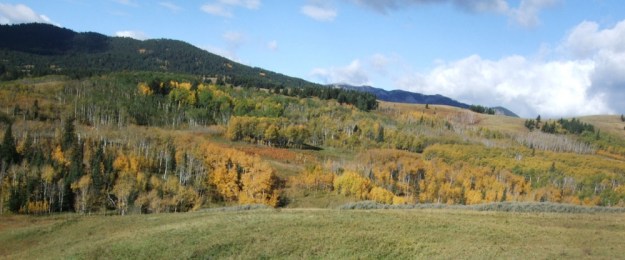
This site contains parts of the valley and associated ridges of the Whaleback area, relatively undisturbed montane and subalpine habitats.
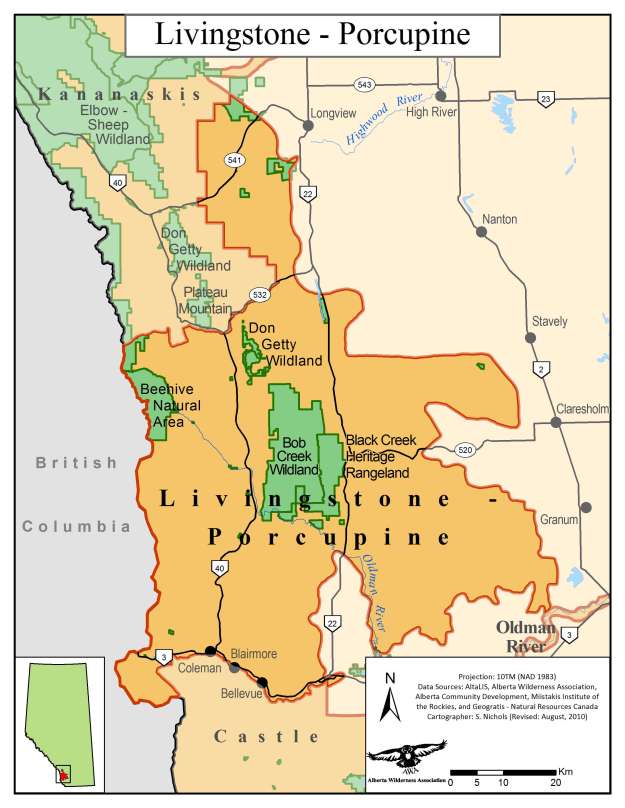
- Map of the Area
- Other Information
- Biophysical Observations (via iNaturalist.ca)
- Site Statistics
- References
- Further Reading
Map of the Area
Any maps and map views are for general information only. Do not rely on them for navigation or to determine legal boundaries.
Other Information
The Whaleback is considered the last remaining area of wilderness montane habitat in Alberta. It is also protected by the large Bob Creek Wildland Provincial Park that lies to the north and west of the HR.
“Elk and Mule Deer migrate into the area during the late fall and winter months to feed on wind blown ridges and south-facing, grass covered slopes. In recent years, the importance of this area to small elk herds during the summer months has increased. Whenever large concentrations of ungulates congregate, large predators that are dependent on these prey species follow. Wolves, coyotes, and cougars regularly range through the protected areas. During the summer, black and grizzly bears travel through and forage in the area.” [1].
Bison and Ranchers. Historically, the area was used by Aboriginal people, primarily to hunt bison. With the extirpation of the bison around 1880, ranchers began using the highly productive fescue grasslands to build their cattle herds, and cattle ranching has been the dominant land use in the area since that time. Other past land uses have included limited timber harvesting and some geophysical exploration. A 500 kV transmission line parallels Whaleback Ridge on its eastern side, crossing through the Black Creek HR [1].
OHV and Whales Don’t Mix. The ‘Whaleback’ is the colloquial name for the region that lies within the Bob Creek Wildland Provincial Park and Black Creek HR; it is so named for the resemblance of its prominent ridges to the spine of a beached humpback whale. It is part of the Alberta Wilderness Association’s Livingstone-Porcupine Area of Concern. Motorized recreation has in recent years led to damage to the Bob Creek Wildland Provincial Park’s streams and riparian areas; its trail systems have too many stream crossings in areas that cannot sustain such intensive use [2].
Biophysical Observations (via iNaturalist.ca)

Are you a member of iNaturalist.ca? It is free to join and you can help nature by making observations with your smart phone.
If there are no or only a few observations, how about visiting and adding some? While there, complete a site inspection report (but read the Site Inspections terms and conditions first).
Observations & Projects for this Natural Area
- Observations for this Natural Area.
- No iNaturalist Projects.
Site Statistics
| Site Name | Black Creek |
| Site Type | Heritage Rangeland |
| Subtype | Order-in-council (OC) |
| Natural Region(s) | Montane |
| O.C. No. (Land Ref. Manual) | 139/2008 |
| PASite ID (Map Ref #) | 584 |
| Site # (Parks Website) | 430 |
| Total Area | 7733.10 ha. (19108.23 ac.) |
| Steward-Status | |
| Recreation Activities | none noted |
| IUCN | VI |
| Operated By | Parks Division |
| Notes and Comments |
References
The following links are provided as a courtesy but are not verified or endorsed by SAPAA. Clicking on the link will cause you to leave the SAPAA website. Primary source of information is: Information & Facilities – Black Creek HR | Alberta Parks (All links accessed on 2023-01-23).
- Alberta Government, Bob Creek Wildland and Black Creek Heritage Rageland Management Plan (July 2011).
- Alberta Wilderness Association, Issue of Concern: Whaleback.
 SAPAA
SAPAA 