The content discusses how Alberta’s protected areas, managed under WAERNAHR, offer resources for Scouts to engage with nature. Utilizing the iNaturalist application, Scouts can contribute to citizen science, learn land ownership principles, and participate in site inspections, enhancing their outdoor experience while fulfilling badge requirements effectively.
- Overview
- Learning Objectives of the Presentation
- Introduction and Landownership
- Scouts, Seek, and iNaturalist
- Nature Alberta’s Children’s Program
- The ‘Question’ and Resource Recap
Overview
Scouting has nature in its DNA. Beyond provincial and federal parks, Alberta’s protected area system covered by the Wilderness Areas, Ecological Reserves, Natural Areas, and Heritage Rangeland Act (WAERNAHR, pronounced ‘Werner’).
SAPAA has online resources that are complemented iNaturalist.ca and Nature Alberta’s Kids content. Noting the need to scale to the ability and risk tolerance of the group, these resource can help Scouts and Scouters complete some of their badge requirements.
More practically, the Scouts can use technology to contribute to citizen science through the iNaturalist.ca application. Visiting a protected area, making observations of common plant (or animal) species, and then returning to see how these become part of a larger data set about the area gives the Scouts a full circle of understanding.
Learning Objectives of the Presentation
Learning Objectives (included or modified as applicable to the age group):
- Understanding the basic principles of land ownership including the role of private, Crown, municipal, Crown-Lease, First Nation, and Land Trusts.
- Understanding the responsibilities each of the above landowners has.
- Knowing what sites can be visited without prior permissions and which ones require permissions.
- Understanding why some sites have amenities (washrooms, trails) while others are in a natural state.
- How an individual can contribute to the body of knowledge about the sites by using iNaturalist or submitting a Site Inspection Form.
- Understanding how iNaturalist works and seeing the full cycle of viewing a site beforehand, visiting a site and making observations, seeing the observations on the site afterwards.
- Understanding the role of a SAPAA site inspection and how this information complements the iNaturalist observation and is used by the public and government.
- The importance of planning and scaling a visit to a person’s abilities including what are the hazards in the sites.
Introduction and Landownership
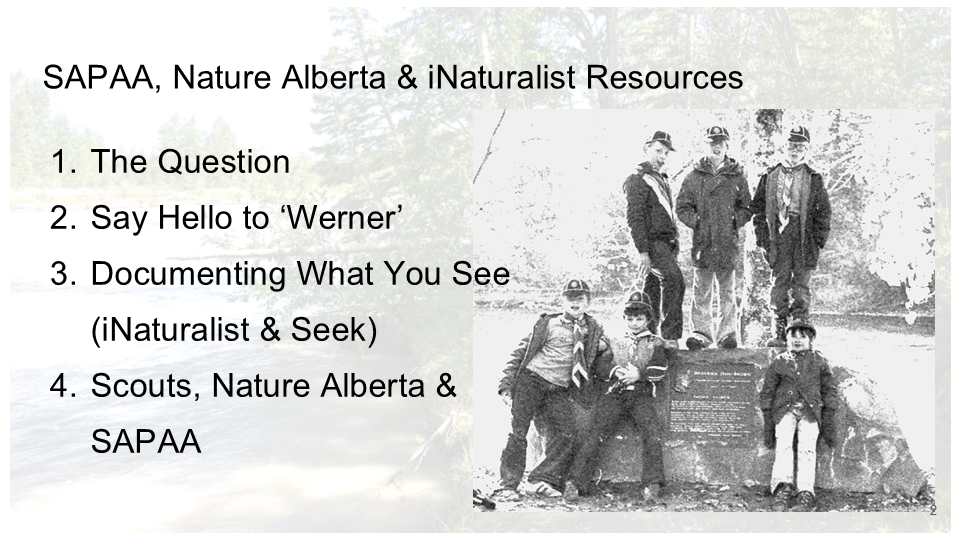
Scouting and the outdoors go hand in hand. So, let’s talk about resources available to Scouting from SAPAA, Nature Alberta, and iNaturalist.

Most people are aware of federal and provincial parks. These are public lands. In addition, organizations such as the Edmonton Area Land Trust or Ducks Unlimited grant access to their privately owned properties.

There is another category of public lands, a system of protected areas covered by this Act. The name is long, so we just call it “Werner”.

Werner is alive and well and can be found in 248 different locations across the province. These protected areas are often small and isolated.
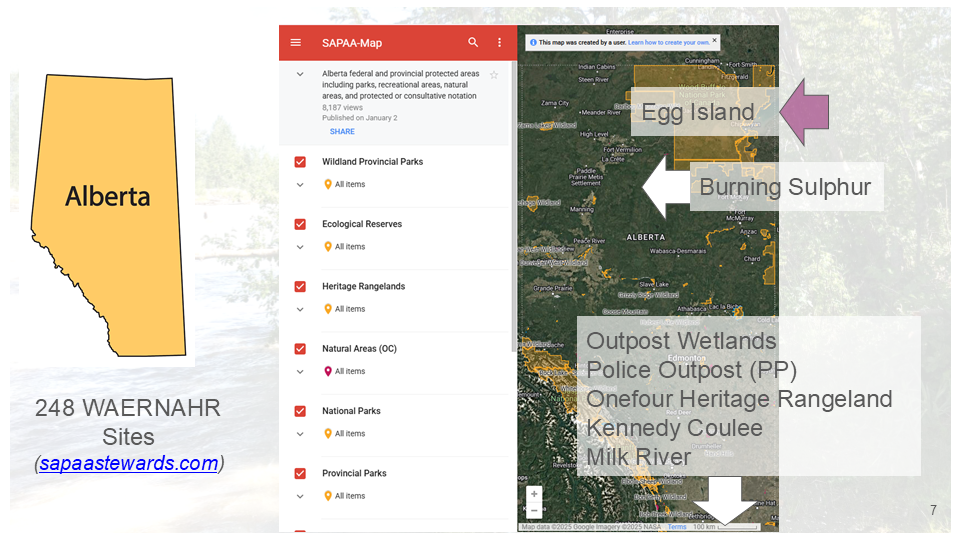
Some are on the border with the United States (Outpost and Onefour). Egg Island is less than an acre and protects rare bird habitat. Burning Sulphur smells like rotten eggs as a result of exposed iron-sulphide minerals oxidize rapidly producing steam and 300C heat.
These sites conserve unique plant, geological, or cultural treasures and provide critical stepping stones for flora and fauna.
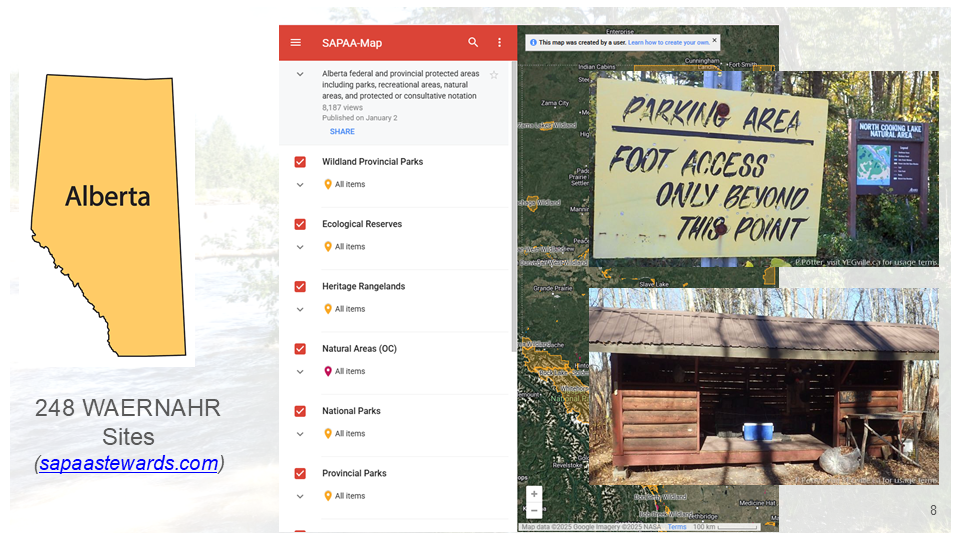
The sites can be used for responsible, low impact recreation. A few have amenities such as signs and washrooms (North Cooking Lake Natural Area, Wanisan Lake (PNT) Natural Area). These protected areas were set aside over the past fifty years and are held in trust for all Albertans.
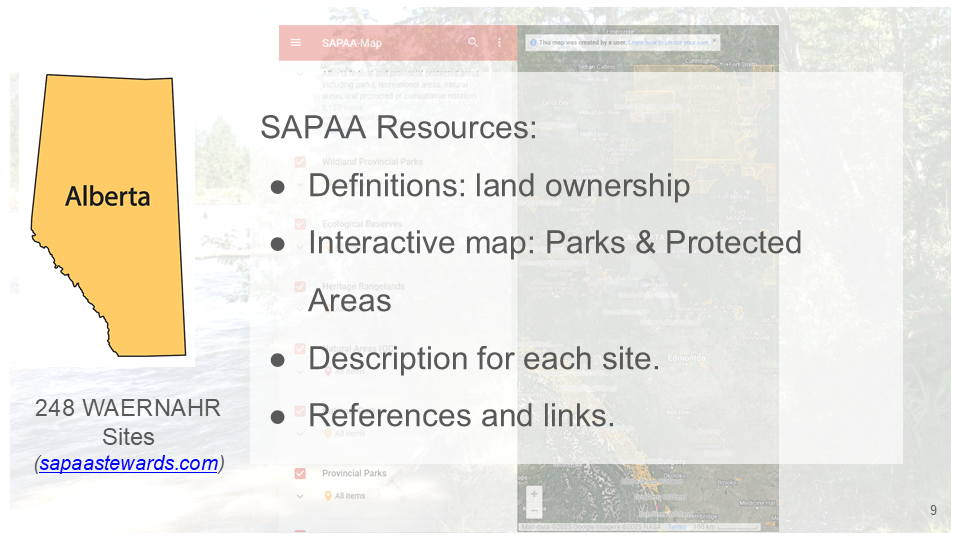
These are the resources that are available to the public from the SAPAA website (land ownership, Google map, Connect and Read).

Land Ownership is a confusing topic and it is important to have a good understanding to avoid trespassing, or discovering you are in the same field as a rancher’s bull. SAPAA can help you research the protected areas to visit, when are permissions required, and who you ask.
Scouts, Seek, and iNaturalist

For kids, nature can be boring Let’s face it, Nature is boring. Wind blowing through the trees in a peaceful forest is bucolic and very, very boring. So, how about gamifying nature?

What is this tree called, how did the First Nations use it, or is it an introduced species? These are questions kids love.
Enter iNaturalist, a social media tool that gathers individual observations and aggregates them into a story.
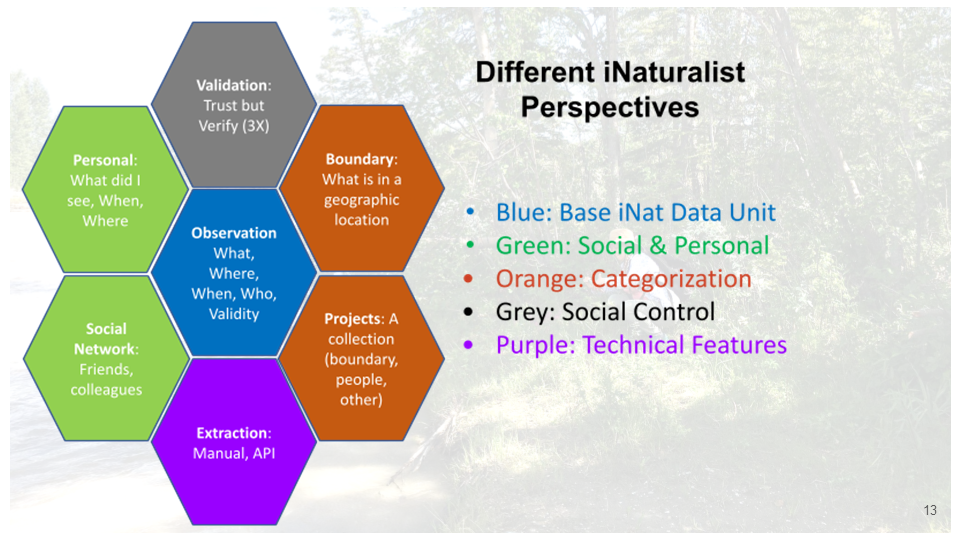
This is the conceptual model of iNaturalist. The following focuses on the blue and orange hexagons.
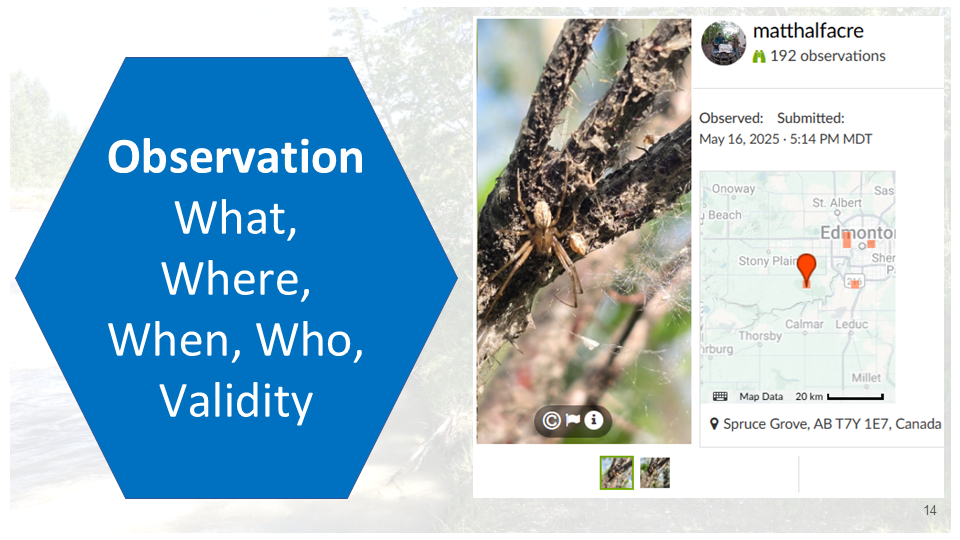
An observation is made by a user. An AI tool can assist with the identification of the observation but humans are still central. An observation is considered research grade if verified by three other iNaturalist-members.
Individual observations can be re-combined and presented in different ways.

The image on the screen are all observations found in Metro Edmonton. This dashboard let’s you ask questions such as: how common is a species in Edmonton, is climate change modifying the distribution of a bird population, or is this plant or animal invasive?

Think of iNaturalist as Pokémon-Go but with a purpose; but appropriate parental controls are critical. Children under 13 require parental approval to sign up for the app. ‘Seek’ is designed for younger children and so may be the best place to start.

Beyond the single observation is the collection or boundary. This is where iNaturalist comes back to Werner and the natural area. Here are the observations for Lois Hole Provincial Park. They are contained within something called a geographic-boundary. Scouts can return to the same spot to re-observe the same species, what is growing next to it, or how it fits into a micro-ecosystem?
Observations can also be collected into a project. A project can contain boundaries, include or exclude species or iNaturalist members.
For example, a Scout group can set up a project and then revisit it at different times and year over year.
Nature Alberta’s Children’s Program

SAPAA is a member of Nature Alberta who has developed lots of content for different age groups. If the SAPAA resources or iNaturalist is not a fit, Nature Kids may help you round out your badge program.
The ‘Question’ and Resource Recap

- The SAPAA website provides the big picture of Protected Areas.
- The iNaturalist or Seek allows Scouts to contribute nature-knowledge.
- Nature Kids is extensive library.
- Site Inspections allow older youth to comment on the state of an area.
Are the resources presented useful for a Scout Program?
If not, how can they be improved?
 SAPAA
SAPAA 