The guide outlines safety protocols for SAPAA volunteers. It defines volunteer criteria, detailing responsibilities for site visits and documentation. The Safety Officer oversees policy updates and training. Volunteers must complete a visit procedure, including hazard assessments, ensuring a safe experience in protected areas.
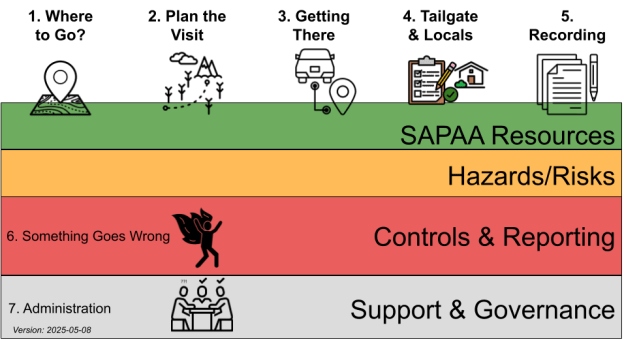
This guide provides practical safety information for SAPAA volunteers and is part of a Safety System which involves six distinct steps. The seventh, Administration step provides the policies for the manual.
- General Safety Policy and Statement
- SAPAA Volunteer Definition Policy
- SAPAA Participation Policies
- SAPAA Default and Required Acceptance Policy
- SAPAA Safety Manual
General Safety Policy and Statement
SAPAA is a volunteer based organization. Volunteers run the board, visit sites, and everything in between; THANK YOU!
In an Alberta, a volunteer is classified as an “unpaid employee” under OHS legislation. As a result, SAPAA will only ask you to volunteer when it can be done in a safe manner. Compliance with the OHS act is important, giving volunteers a safe and enjoyable Protected Area experience is paramount.
Further Information on OHS
The Alberta’s Occupational Health & Safety (OH&S) Act (SA 2020 c0-2.2):
“Volunteers who perform or supply services to an organization or employer without being paid are defined as workers in Alberta’s OHS Act (with the exception of farm and ranch volunteers).
“Volunteers are only not considered to be workers of an organization if the organization has not formally or informally accepted the use of their volunteer services.
OHS Act definition of Lone-worker
(Adapted from “Working alone: OHS information for workers and employers“)
When is a worker working alone? The working alone requirements in Part 28 of Alberta’s OHS Code apply when both of the following conditions are met:
- Workers are working by themselves.
- Assistance is not readily available to the worker if there is an injury, illness or emergency.
What does ‘Readily Available Mean’? Three factors determine whether assistance is “readily available” in the event of an injury, illness or emergency:
- Awareness: Will other people capable of providing assistance be aware of the worker’s
needs? (e.g. a passing motorist, a travel mate) - Willingness: Is it reasonable to expect that these other people will provide helpful
assistance? (e.g. call 911, render first aid, drive the injured to a local hospital) - Timeliness: Will assistance be provided within a reasonable period of time?
Order of Precedence and Updates, Application and Scope
- PRECEDENCE. The policies, procedures, and resources of the SAPAA Health and Safety Program (Program) do not take precedence over the Alberta Occupational Health and Safety (OHS) Act, Regulations, and Code (collectively referred to as “OHS legislation). In the event of a discrepancy, OHS legislation takes precedence.
- APPLICATION. The Program applies to all SAPAA volunteers and any future employees or contractors.
- SCOPE. Due to the nature of SAPAA’s work, it is impossible to anticipate every situation that may occur in the field. SAPAA volunteers are expected to use the general principles described in the program and extrapolate as required to the specific circumstances. When in doubt, OHS resources can also be consulted.
OHS Act and Use of a Personal Vehicle
Personal Vehicle for Work Purposes; (290.1)
If a worker uses a personal vehicle for work purposes,
- (a) an employer must ensure that the worker complies with section 256(1) by complying with the appropriate licensed driver requirements of provincial legislation, and
- (b) the worker must ensure that the vehicle is maintained in sound mechanical condition.
Specific SAPAA Policies: Email Signatures and Records
Email as Electronic Signature
SAPAA will not collect physical copies of forms but instead will exclusively use digital versions. The email associated with a SAPAA membership or a SAPAA domain email (e.g. @sapaastewards.com) is considered a legally binding signature. This not only reduces costs but it also improves the record retention for this information.
Record Retention of Information Collected
Unless there is a hold on these records, they can be destroyed after two full program years have passed since the form’s completion and typically in the calendar year following this requirement
A form submitted on October 2, 2031 (one day after the start of the program year) can be deleted on or after September 30, 2035. Most likely it will be part of an annual purge after January 1, 2036.
SAPAA Overall Programmatic Objectives
SAPAA’s core volunteer activity is visiting a designated site, making observations, and submitting a site inspection report. These reports are amalgamated into reports including an annual Minister’s report.
Secondary activities includes communicating and educating about Alberta’s protected areas, and assisting in approved site remediation and research activities. These activities are both in the field and otherwise (e.g. done via virtual meetings).
Multi-Day Trip Policy
Multi-day trips are unusual and must be pre-approved by the SAPAA Board. The following policies provide guidance to the SAPAA Volunteer and Board for when to apply for such a trip or whether or not to approve it.
Definition of a Multi-Day Trip
A multi-day trip is one that an individual remains a SAPAA volunteer overnight. The reason for a multi-day trip is the nature of the site being visited and the effort to return to it in successive days.
Multi-Day Trip Policy
A multi-day trip must be approved in advance by the SAPAA Board and include additional Safety Hazard and Programmatic Value Assessments. As required, the board will purchase additional insurance riders for the trip.
A multi-day Trip must demonstrate value to SAPAA as opposed to traveling convenience to the SAPAA Volunteer. If a large portion of the time for a such a trip is not spent in a Protected Area, the Board will typically not approve it.
Alternatives to Multi-Day Trip
SAPAA Volunteers may choose to register individual site visits that are part of a multi-day trip. For example, a 3-night canoe trip in which visits to 2 protected areas along the river are planned. The SAPAA Member would register the two site visits.
The individual is only a SAPAA Volunteer when stopping one private activity (canoeing) and starting the SAPAA activity (walking towards the Protected Area). The reverse is also true, once leaving the Protected Area, the individual ceases to be a SAPAA Volunteer.
In assessing when one activity starts and the other stops, Substance over Form prevails.
SAPAA Volunteer Definition Policy
Defining when a person is a volunteer for a nonprofit is critical as it determines when responsibility transfers from the individual to the organization. OHS recognizes three steps that must be completed:
- The organization is asking for a person to volunteer (we are asking!)
- The person agrees to volunteer (as evidenced by completing an Intent to Visit Statement).
- The organization accepts the volunteer (see Level 1 and 2 requirements below).
Changes to a Planned Trip Policy
A SAPAA Volunteer may make reasonable changes in the field to their trip assuming they have take the necessary precautions to communicate the changes to any support systems they have (particularly for Lone-Volunteers) and re-assess the Hazards associated with the new site.
Changes in Risk Assessment
- If the new site represents substantially higher risk then the SAPAA Volunteer must submit a new Statement of Intent to Visit. This can be done online via a cell phone.
- Changes to sites representing lower or approximately equivalent risks do not require a new Statement.
SAPAA Safety Officer and Other Roles Policy
Annually, the SAPAA board will identify a Safety Officer. This volunteer is Accountable for safety. This individual keeps the policy and manual up to date, coordinate volunteer training, administer examinations, and designates Qualified Members. This position also ensures all incidents are documented and serves as a liaison with the insurance company in case of a serious incident.
SAPAA Volunteer Responsibility
All SAPAA Volunteers are Responsible to correctly apply this program to their specific circumstances.
Supervisors
A supervisor or Field Trip Leader will be assigned for SAPAA group outings. When visiting a site alone or with 1-2 individuals, a supervisor can be nominated otherwise all SAPAA Volunteers are assumed to be responsible to supervise their own activities.
Health and Safety Committee
- At least annually, SAPAA will conduct a review session to enhance the Program.
- Volunteers may choose to elect an independent representative or rely on the SAPAA Safety Officer to represent their interests.
- SAPAA will consult with industry experts, its volunteers, and peer organizations to best balance a compliant safety program with its practical implementation.
Minors on SAPAA Events
Minors (under the age of 18) are welcome on SAPAA events with the following provisions:
- A Minor cannot be a SAPAA Volunteer as they are not considered a competent adult.
- Minors must be accompanied by an adult at all times.
- Noting the exception of the designated adult responsible for the minor:
- At no time can a SAPAA Volunteer, who is not responsible for the minor, assume responsibility while on Trip (emergencies notwithstanding).
- A SAPAA Volunteer or other members of a trip must never be left alone with a minor; two adults must always present at all times.
SAPAA Participation Policies
The following policies set the context for how SAPAA Volunteers may operate in the field. At this point, the province does not permit SAPAA to complete repairs or maintenance to Protected Areas (e.g. re-hanging or replacing signs).
Seven Levels of Participation Policy
SAPAA recognizes seven levels of interest, participation, volunteers and member interaction with the organization. In ascending order of training and expertise they are as follows:
1. Public
Individuals and organizations that are not currently a SAPAA member.
- Members of the public can submit Site Inspections or iNaturalist observations.
- A members of the public is NOT a SAPAA Volunteer.
- They are welcome to use the publicly available information noting the limitations of use:
- Maps, iNaturalist, etc. is for information and should not be relied upon in particular for navigation or determining legal boundaries.
- All materials are provided without any guarantees of their accuracy, completeness, or being up to date.
- Participants on a trip organized by an organizations (e.g. local nature or hiking clubs) are considered members of the public.
2. Nearby Resident
- An individual organization who maybe a currently registered SAPAA member but more importantly lives nearby a protected area(s).
- They are encouraged to submit a site inspection but are not considered volunteers.
- SAPAA maintains a list of such Stewards and communicates with them individually and as a community.
- They are invited SAPAA events but are they are not a voting member.
- They are encouraged to become a voting member and complete volunteer-training but this is not required of them.
3. SAPAA Member (non-volunteer)
An individual organization who is a currently registered SAPAA member. They may receive or request additional information about a site that is not publicly available. Members are not automatically assigned a volunteer status.
4. Trip Participant (non-volunteer)
A public or SAPAA member taking part in an official event such as a field trip. They are not considered volunteers although they may be encouraged to make iNaturalist observations or submit Site Inspection reports.
5. Volunteer – Trip Leader
A SAPAA member or invited guest leading an activity. Preparing, running an debriefing an event the individual is a SAPAA Volunteer and must follow relevant SAPAA procedures (including Safety assessments).
6. Level 1 – Volunteer
Level 1 – Volunteer: A SAPAA volunteer who has taken relevant SAPAA training (including Safety) and can volunteer to visit a Protected Area noting:
- The individual must follow relevant visiting and safety protocols.
- These protocols including carrying recommend safety equipment and material.
- There must be at least two Level 1 or 2 Volunteers on each trip.
- Up to three guests per Level 1 or 2 Volunteers may register for and attend the trip.
- The individual should hold a valid First Aid certificate.
- SAPAA reserves the right to not approve trips to Protected Areas deemed high risk.
7. Level 2 – Volunteer
Equivalent to a Level 1 Volunteer with additional advanced training in the following:
- This individual is approved to follow the Lone-Volunteer protocol and
- May be issued additional safety equipment to support these efforts.
- The individual must hold a valid a First Aid certificate
SAPAA Level 2/Lone Volunteer Policy
SAPAA understands that it is often easiest and most productive to visit a site by yourself. Unfortunately, a Lone Visit also increases the risk to the SAPAA Volunteer. Therefore, our policy is as follows:
- SAPAA Volunteers must visit a Site with another volunteer or a guest.
- A guest must be a competent adult, completed a Visit Procedure, be able to summon help in an emergency, and ideally drive the vehicle which got you to the site.
- If a companion is not practical, then only Level 2 Volunteers are approved for a Lone Visit.
- To approve such a visit, the Level 2 Volunteer must complete an additional Hazard Assessment.
- There must be an effective means of communication between the Lone Volunteer and designated individual who will monitor their status per the Lone-Volunteer Procedure.
- The Volunteer may be required to invest in approved satellite communication technology as cell coverage is not considered an effective means of communication for some Protected Areas.
SAPAA Cost Reimbursements and Honorariums Policy
SAPAA bylaws does not permit remuneration of members or board members. As a result, the Society does reimburse SAPAA Volunteer costs except as a honorarium. Honorariums have the following conditions and principles:
1. At board discretion and paid only as funds are available.
As funds are available, and at the discretion of the board, honorariums can be paid to all SAPAA Volunteers (including those serving on the board).
Honorariums acknowledge the contributions of the SAPAA Volunteer as opposed to a dollar for dollar reimbursement of out of pocket expenses. Shortfalls of a honorarium as compared to expenses incurred will not be covered by SAPAA. Conversely, if a SAPAA Volunteer receives a small and reasonable surplus, this need not be refunded to SAPAA; larger amounts should be returned to SAPAA.
2. Purpose of the Honorarium
The purchase of equipment, materials, access to software and other personal and incidental costs. For example, the honorarium will cover purchasing a larger data plan for a cell phone to allow for iNaturalist submissions.
3. Tax Liabilities and Donations of Honorariums
To the maximum extent possible, an honorarium will be structured to be non-taxable for the SAPAA volunteer; nevertheless, the individual is responsible for any tax implications.
If a SAPAA Volunteer prefers not to receive an honorarium, SAPAA will attempt to facilitate a charitable receipt for the value of honorarium refused. This is subject to administrative capacity of the organization.
4. Annual Establishment
The rate and conditions of the honorariums will be set by the board annually and available to all members. This includes modifying or changing any of the following by updating this policy through a minuted board motion. The determination of any honorariums is reset annually at a date determined by the board.
5. Honorariums fall into three categories: General, Travel, and Exceptional.
- General honorariums are intended to cover the cost of complying with the SAPAA Safety and Site Visit programs. It recognizes there are many hidden costs associated with volunteering such as using more cellphone data.
- Travel honorariums are intended to offset the costs of using a personal vehicle (gas, wear and tear, consumables).
- Exceptional honorariums are at the discretion of the board and are used to encourage and facilitate SAPAA programmatic objectives.
6. General Honorarium principles are as follows:
- The SAPAA Volunteer is expected to reasonably contribute to the costs of visiting sites particularly if funding is not available to the Society.
- No further reimbursement of costs will be made.
- Honorariums will not be paid unless there is a benefit received by SAPAA (such as a Site Inspection report).
- Honorarium reimbursement to a SAPAA Volunteer increases as the number of Site Visits over the course of a program year.
7. Travel Honorarium principles are as follows:
The board may make exceptions to the following.
- Travel Honorariums are meant to partially cover the costs of operating a personal vehicle.
- Where practical, a group traveling to a site should attempt to car pool. Saves on Honorariums, reduces emissions, and you can meet new friends!
- SAPAA Volunteers are required to pre-estimate their mileage for a trip which should include detours such as picking up other members.
- Any estimate should be rounded up to the nearest five (e.g. a 58 KM trip is rounded up to 60 KM).
- The board will consider significant changes to a pre-estimate (e.g. an accident requires a long detour to return home).
- Ideally, a Travel Honorarium will cover up to about 75% of the current Canada Revenue Agency mileage allowance.
- Further allowances for multi-day trips or vehicle rentals must be pre-approved.
SAPAA Volunteer Authority and Communications Policy
When you’re on site, people may approach you. You may also initiate contact with nearby residents. SAPAA Volunteers can share site-knowledge, Alberta’s Protected Area system, SAPAA, and its peer organizations. Knowledge sharing can range from answering questions or providing SAPAA material such as brochures [LINK, pending].
Limitations of this communication includes the following:
- Public Advocacy: topics and opinions not expressly endorsed by the Board must be prefaced with opinions are those of the individual and not SAPAA.
- Confidentiality of Information: SAPAA Volunteers have access to privileged information. Only information publicly shared by SAPAA can be released without approval of the Board.
- Authority: A SAPAA Volunteer has no legal or enforcement authority. Recording of destructive or illegal activities underway can be recorded only to the extent the individual feels comfortable doing so.
- Handling Complaints: If a nearby resident or member of public has a complaint about the site, the SAPAA Volunteer can note and include it in their Site Inspection report. Under no circumstances should the individual suggest they have authority to address the issue.
- Use Existing Authorities: SAPAA Volunteers must direct all queries or requests for action to the relevant authority. These are listed annually as part of the Site Inspection process.
Personal Vehicle and Driving Policy
A personal vehicle is considered a worksite under OHS legislation. SAPAA is responsible to ensure the person operating a vehicle can legally and responsibly due so and the vehicle’s owner must ensure it is in good working condition. In addition to the following policy statements, additional information can be found in the 3. Getting to Your Visit Operations Procedure. Additional guidance is available from the Alberta Government: Driving safety : OHS information for employers and workers – Open Government.
Need for a Personal Vehicle or a Ride Share
Implicit in the request to volunteer with SAPAA is access to a personal vehicle or ride share arrangement. Personal vehicles are the most common form of transportation, particularly for Level 2 volunteers visiting sites by themselves.
Ride share is typically another volunteer or a guest of the volunteer. It is possible but unlikely to arrange for commercial ride share services (e.g. taxi, Uber, etc.) given the remote nature of the sites. Public transit is deemed impractical for all but the most urbanized of the sites.
Safe Driving Policy
SAPAA is committed to safe driving for its volunteers (and anyone else getting into a motor vehicle). Although many of the following are mandatory legal requirements of using a motor vehicle, they are also SAPAA policy and common sense:
- Legally Entitled to Drive: Only individuals having a valid drivers license, vehicle registration, and insurance may use their personal vehicle as a Volunteer.
- Competent Driver: Only individuals physically and mentally competent may drive as a SAPAA volunteer. Reasons for the loss of competence may include illness, fatigue, etc..
- Driving Impaired: Volunteers must not be over the legally alcohol limit and preferably abstain completely from drinking while driving as a Volunteer.
- Driving Distracted: Volunteers must not drive distracted. For example, using hands free devices for phone calls and navigation.
- Seat Belt Usage: The driver and all passengers must use an approved seatbelt.
- Vehicle Maintenance: The driver must ensure the vehicle has been maintained to manufacture’s specifications. If this guidance is not available, then at a minimum, the operator of a vehicle must:
- Employ a certified technician to perform maintenance where required.
- Perform a pre-trip inspection.
- Have a certified technician do a thorough inspection of each vehicle regularly.
- Emergency preparedness: The operator of a vehicle must ensure that they are ready for reasonably anticipated emergencies due to weather and other factors.
- Ergonomics: Particularly for longer distances, the driver must ensure the vehicle is comfortable to operate and travel in.
- Long Distance Driving: For trips more than sixty minutes in length, the driver must stop at least every hour for a rest break.
- Discretion as to the exact timing is up to the driver, for example, driving a bit further to get a rest stop area.
- Drivers should not driver more than eight hours in one day as a Volunteer.
- If a longer duration is required, driving duties should be shared between two or more eligible drivers or broken up over multiple days.
Workplace Harassment and Violence
The nature of SAPAA’s work minimizes the incidences of harassment or violence. Level 2 volunteers may visit sites by alone or long time friends team up for trips. Conversely, the isolated nature of these activities makes the impact of these events more severe.
SAPAA Volunteers (and Workers) Responsibilities.
SAPAA Expects its volunteers, board, and any employees to behave as adults and treat others with the respect they deserve. Specific responsibilities include:
- Be mindful and treat each other with respect,
- Through your words and actions, protect your and your co-workers’ psychological and physical health,
- Know how to identify workplace harassment and violence and how to report incidents,
- Maintain confidentiality of the individual(s) concerned,
- Participate in site hazard assessments to minimize risk related to workplace harassment and violence.
SAPAA Board Responsibilities
- Foster an organizational culture that promotes psychological and physical health and safety and zero tolerance for workplace violence and harassment,
- Ensure reported incidents are investigated in a timely and objective manner following SAPAA policies and procedures,
- Advise the individual(s) involved to consult a health professional if the individual reports physical or psychological injuries or adverse symptoms,
- Maintain the confidentiality of the individuals concerned, except where disclosure is necessary for investigating purposes or taking disciplinary measures,
- Be familiar with and ensure compliance with Occupational Health and Safety Act, and Alberta Human Rights Act.
Identifying Workplace Harassment and Violence
- Workplace harassment is a single or repeated incident of objectionable or unwelcome conduct, comment, bullying, or actions by a person that causes offense or humiliation to another individual.
- Workplace Violence is the threatened, attempted, or actual conduct of a person that causes or is likely to cause physical or psychological injury or harm, and includes sexual violence.
The above should not be confused with any reasonable conduct of a supervisor or the the SAPAA Board in respect to the management of workers in the workplace. Examples of reasonable conduct may include feedback on tasks, duties and related deadlines, performance reviews, and discipline.
Reporting Workplace Harassment and Violence
The following provided SAPAA policies and general guidance. Specific procedures are available: Workplace Harassment and Violence Procedure.
- Annually, the SAPAA Board will revise and publish procedures for workers to report and management to investigate incidents of workplace violence and harassment.
- Criminal Allegations: If the worker or the board considers the matter to be criminal in nature, it will be immediately forwarded to the appropriate authorities.
- Actions will occur per the advice of the authorities so as to not interfere with investigations.
- If the matter is deemed to be non-criminal, the following can occur with a revised reporting date when the incident was deemed non-criminal.
- Personal Resolution: First and foremost, differences in approach, communication styles, and humour should be discussed between the individuals involved. If the complainant is not comfortable doing this, then they may follow the prescribed reporting reporting procedures.
- Record Retention: all aspects of reporting and investigation are strictly confidential. The documents corresponding to the investigation will be kept on file in a secured location for two years from the date of the reporting.
Reporting and the Role of Nature Alberta
Nature Alberta will be informed by the President or designate of any ongoing investigations. As required, the board may request the assistance of Nature Alberta.
SAPAA Default and Required Acceptance Policy
SAPAA accepts by default all Intents to Visit from Level 1 and 2 volunteers with the following exceptions:
- The visit is assessed as high risk by the SAPAA Volunteer and as such additional approvals are required (e.g. an email is sent to the volunteer from the Safety Officer clearing the trip).
- The SAPAA Volunteer is new and is under an (un)official probation period.
- The board has placed restrictions on the SAPAA Volunteer or the site warranting further risk assessments.
SAPAA Volunteer Policy
You are engaged as a SAPAA Volunteer when you meet one of the following criteria:
- A member of the SAPAA Board, or
- Temporarily leading or playing a support role in an organized SAPAA event such as a field trip, or
- SAPAA has designated you a Level 1 or 2 Volunteer and you follow the SAPAA Visit Procedure described in this Safety Manual.
You are NOT engaged as a SAPAA Volunteer if You…
- Are not a Level 1 or 2 Volunteer SAPAA Member.
- Have not completed the SAPAA Visit Procedure in Advance of visiting a site.
- Are attending as a participant an organized SAPAA event such as a field trip
Individuals and organizations may visit or remediate Protected areas based on agreements they have with the province. In addition, a nearby resident may be interested in a site. These individuals are only a SAPAA Volunteer if they meet the above criteria.
To Become a Level 1 or 2 Means You …
- Are a registered member, AND
- A competent adult, AND
- Taken or Refreshed your Level 1 or 2 Certificate for the current program year.
Membership is the basis for SAPAA’s insurance and you must be a member to volunteer. A Level 1 or 2 involves training, passing an examination, and then updating the certificate annually. Prior to visiting a site, there is one more step.
SAPAA Visit Procedure Policy
Complete an online form in ADVANCE of visiting a site. The form will help you plan your experience and ensure that you do safely. Critical elements of the form include:
- Statement of Intent to Visit (where are you going, when and permissions).
- Lone, Group, and Guest risk assessments (see Policy Statement Below).
- Seasonal hazard assessment (what are the hazards and how will they be mitigated).
- Confirmation of Return from Visit.
Statement of Intent to Visit (Statement) Policy
- SAPAA Volunteers must declare their intent to visit a site in advance by completing a ‘Statement of Intent to Visit‘ (Statement).
- It includes a hazard assessment and helps the SAPAA Volunteer prepare for a visit. For example, reviewing past inspections, photos, and other details about the site.
- The intent to visit must be completed in advanced. For higher risk Protected Areas (e.g. remote), the Board reserves the right to pre or not approve a visit.
- The SAPAA Volunteer is responsible to assess the need for a new Statement if changes are required to the trip. How to make this assessment is part of the Level 1 and 2 Volunteer Training.
Accessing or Crossing Private or Leasehold Properties
SAPAA requires all SAPAA Volunteers to obtain permissions from landowners or leaseholders before entering or crossing their land which otherwise does not have public access. If in doubt, ASK or don’t GO!
A Seasonal Hazard Assessment Policy
SAPAA Volunteers must consider and control for Seasonal Hazards. While common sense and personal judgment prevail. SAPAA requires that planned site inspections be canceled because of inclement or hazardous conditions. This include (but are not limited to):
- Poor driving conditions caused by snowfall, heavy/freezing rain, hail, flooding, etc.
- Poor air conditions caused smoke, extreme cold, etc.
- Expected temperatures below -25 C or above 25 C (including wind chill).
- Higher than normal pests such as ticks, mosquitos, etc.
Confirmation on Return Policy
Unless requested to do so, SAPAA will not monitor the return of a SAPAA Volunteer. Instead, the individual is expected to follow a return from volunteering procedure. In most cases, this is as simple as calling a spouse and saying you are ‘on my way home’. For a SAPAA Volunteer without suitable familial support, a designated individual who is a competent adult is required.
These and other considerations are discussed in greater detail in the following manual.
SAPAA Safety Manual
The Safety Manual includes the above policies and other sections divided chronologically into the following steps. Not all activities are safety related but are referenced here to make this guide as practical as possible.
- Where To Go?: Considerations on picking a destination.
- Planning the Visit: Group Size, Hazards and Maximizing Your Visit.
- Complete an Statement of Intent to Visit (Statement).
- Getting There: Travel hazards.
- Tailgate and Locals: One final safety and readiness check, the Neighbours.
- Recording & Reporting the Visit: Images, GPS, impressions, Close the Visit Procedure Procedure, Submitting a Site Inspection, iNaturalist, Posts and Blogs.
- When Something Goes Wrong: Protocols, Actions, and Reports.
- Administering Safety: Other safety considerations for SAPAA (this page).
| Board Approval / Last Revision Date | [DATE] / [DATE] |
| Board Role Accountable | [POSITION] / [EMAIL] |
| Applies to: | All SAPAA Volunteers, guests, & members |
 SAPAA
SAPAA 
The title Safety Officer is outdated. An updated title is Safety Coordinator or Safety Advisor.
Edit needed (remove “an”): In an Alberta,
The paragraph starting with “PRECEDENCE. The policies, procedures, and resources of the SAPAA Health and Safety Program” MUST be removed. There was a time when it was mistakenly believed that this would somehow absolve an organization of its responsibilities by being sloppy and not informing workers. If an organization does not meet its responsibilities under the Act and Code, they are liable and can be charged in the event of a serious incident. I feel very strongly about this and so do most of the OHS practitioners I know, including a couple of OHS lawyers.
Edit needed (should be taken): assuming they have take the necessary
LikeLike